Stage 2 Fire Restrictions Enacted for Western Boulder County; Stage 1 Fire Restrictions Enacted for Eastern Boulder County.

Boulder County government offices closed Friday, July 3. Trailheads close at 7:30 p.m. on July 4 and reopen at sunrise on July 5.

Wildfire smoke is causing poor air quality. Learn more

Wildfire Mitigation Code Requirements
Architecture blueprints with draft tools placed on top

Wildfire Mitigation Code Requirements

Boulder County’s Wildfire Mitigation program administers building code requirements that reduce wildfire risk and improve safety in unincorporated Boulder County. These standards address ignition‑resistant construction, defensible space, noncombustible perimeters, and other measures that help protect homes and communities from wildfire. Learn more on the Wildfire Mitigation homepage.

Origins of the Wildfire Code

Wildfires are unavoidable in Boulder County and the Western US. The Black Tiger Fire swept through the foothills of Boulder County, Colorado, in 1989, destroying 44 homes and other structures and causing an estimated $10 million in damage. The fire highlighted the need for ignition resistant building codes in the county.

The conditions that principally determine whether a home survives a wildfire occur within 100 feet of the structure. This includes the home’s exterior materials, the surrounding landscaping and vegetation, and the agglomeration of urban and wildland fuels in this area. Boulder County’s Land Use and Building Code addresses these elements to reduce the risk of loss of life and property.

Initial measures to address wildfire resiliency through the building code were adopted in 1989, and subsequently, in the land use code in 1993, and applied to construction in the western part of the county, designated Wildfire Zone 1. At the time, only this area was deemed at high risk from wildfires. The wildfire mitigation code requires the use of ignition resistant and noncombustible materials in home construction and limits the amount of flammable vegetation near homes. These codes have been based on wildfire science findings from the US Forest Service Missoula Fire Science Laboratory, National Institute of Standards (NIST), Insurance Institute for Business & Home Safety (IBHS), National Fire Protection Association (NFPA), Cal-Fire, and the University of California at Berkeley, and sections of the IWUI (International Wildland Urban Interface) Code. The county’s wildfire code requirements have been updated periodically as new science and standards become available.

The eastern part of the county had few notable fire events until the Marshall Fire in 2021. That fire destroyed almost 1,100 homes, including over 150 in unincorporated Boulder County and over 900 in the adjacent cities of Superior and Louisville. This prompted the county to update its building code to include ignition resistant requirements for Wildfire Zone 2 as well, effective June 2022. The codes are a vital part of the county’s wildfire mitigation efforts, and they will continue to play an important role in reducing the risk of loss of life and property from wildfires.

Code Requirements

The code requires wildfire mitigation for all new buildings, additions, alterations, and repairs,

Except:

  • One-time additions not exceeding 200 square feet in floor area.
  • Accessory structures not exceeding 120 square feet (11 m2) in floor area that are located not less than 50 feet (15,240 mm) from buildings containing habitable spaces.
  • Agricultural buildings not exceeding 200 square feet (18.58 m2) that are not less than 50 feet (15,240 mm) from buildings containing habitable spaces.
  • Historic Buildings where the requirements of this section directly interfere with contributing elements of the historic designation.
  • One-time exception, when the reconstruction, replacement, alteration, or repair of the exterior walls of an existing building, when less than 25 percent of the surface area of all exterior walls is affected, compliance with R390.4.6 is not required.
  • One-time exception, when the reconstruction, replacement, alteration, or repair of the exterior roof covering of an existing building, when less than 25 percent of the surface area of the exterior roof covering or an attachment thereto is affected, compliance with R390.4.1 is not required.

The Wildfire Mitigation Code Requirements are generally divided into:

The ignition-resistant construction and materials are largely the same across unincorporated Boulder County.

Defensible Space Requirements

Unincorporated Boulder County is divided into three Wildfire Zones. Full defensible space is required in Wildfire Zone 1 – West County and Wildfire Zone 2 – East County. Full defensible space is NOT required in Wildfire Zone 3 – East County.

View the Boulder County Wildfire Zones Map

In Wildfire Zone 1 – West County and Wildfire Zone 2 – East County, defensible space is required for:

  • New residences or commercial buildings.
  • Additions over 200 square feet (In rare cases, defensible space may be required for additions under 200 square feet).
  • Accessory structures exceeding 120 square feet (11 m2) in floor area or located less than 50 feet (15,240 mm) from buildings containing habitable spaces.
  • Agricultural buildings exceeding 200 square feet (18.58 m2) or less than 50 feet (15,240 mm) from buildings containing habitable spaces.
  • In Wildfire Zone 1 – West County only: Any new covered projections, porches, decks, or deck work requiring a building permit.

Timeline

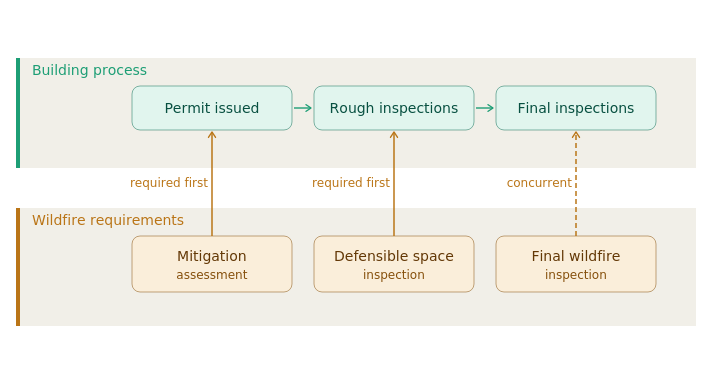
Wildfire compliance diagram. First, permit issuance with a mitigation assessment. Then a rough inspection with a defensible space inspection. Finally, a final inspection with a final wildfire inspection

Defensible Space and the Building Permit Process

Typically, the Wildfire Mitigation Team does not have the capacity for any wildfire mitigation assessments or inspections before a building permit is applied for.

Before the Issuance of a Building Permit

A wildfire mitigation assessment must be completed before a permit is issued. Once a building permit application has been submitted, a Wildfire Mitigation Specialist will contact the applicant. The Wildfire Mitigation Specialist works with the homeowner to select and mark trees for removal to meet the defensible space requirement of the building code. When the assessment is complete, your Wildfire Mitigation Specialist will notify the County Permit Specialists.

Before Scheduling Any Above-Ground Rough Inspections

The defensible space will be inspected before scheduling any above-ground rough inspections, but after the walls and roof have been framed and sheathed. Contact a Boulder County Wildfire Mitigation Specialist at wildfireinspections@bouldercounty.gov for an inspection. The defensible space must be completed by this point.

For new residences in the Four Mile and Sunshine Fire Protection Districts, an Emergency Water Supply is required at this time. A  Fire Cistern Approval Form (W07) must be completed and submitted to Boulder County Building Safety & Inspection Services at ezbp@bouldercounty.gov.

At the Time of Final Inspections

Before a Certificate of Occupancy is issued, all outstanding defensible space work must be completed and inspected. Email wildfireinspections@bouldercounty.gov to schedule this inspection.

The noncombustible perimeter will need to be installed and inspected. The building inspectors will inspect this during the final inspections.

For new residences in Wildfire Zone 1 – West County, for fire districts other than Four Mile and Sunshine, an Emergency Water Supply is required. A Fire Cistern Approval Form (W07)  must be completed and submitted to ezbp@bouldercounty.gov.

Noncombustible Perimeter Requirements

The noncombustible perimeter is required:

  • Whenever defensible space is required.
  • For all new buildings and additions in Wildfire Zone 3 – East County.
  • For all new and rebuilt decks in unincorporated Boulder County.
  • When the reconstruction, replacement, alteration, or repair of the exterior walls of an existing building, when greater than 25 percent of the surface area of all exterior walls is affected.

Additional Requirement for Wildfire Zone 1 – West County

Defensible Space in Wildfire Zone 1 – West County

Homeowners in Wildfire Zone 1 – West County have two options or paths for meeting the defensible space requirements. One is following the building code; the other is obtaining a Wildfire Partners certificate.

If obtaining a Wildfire Partners certificate, and more than five years have passed since the last Wildfire Partners assessment, a new assessment is required. Also, if the homeowner already has a Wildfire Partners assessment or certificate, a follow-up defensible space assessment may be necessary to determine which, if any, additional trees need to be removed due to the change in the building footprint.

More information on the defensible space requirements and the differences between the two paths is available below.

Increased Ignition Resistant Materials in Wildfire Zone 1 – West County

Defensible space and ignition-resistant materials are the two components of wildfire mitigation. Increased ignition-resistant materials are required during a Site Plan Review or Expedited Site Plan Review when full defensible space—typically at least 100 feet in Wildfire Zone 1 – West County—cannot be created and maintained, mainly due to the proximity of the property line.

The main goal of wildfire mitigation is to reduce the potential of anything on the house igniting, because during a wildfire–when firefighting resources are stretched very thin–any ignition on the house could spread to the rest of the home. That is why–when defensible space is compromised– noncombustible materials are required as much as possible.

Noncombustible and ignition resistant materials are fundamentally different. Noncombustible materials do not ignite or burn; in contrast, ignition-resistant materials will ignite and burn, especially after weathering. Confusion often arises because, by definition, noncombustible materials are ignition resistant. However, ignition resistant materials are not noncombustible materials.

When full defensible space is compromised, typically due to the proximity of the property line, increased ignition resistant materials are required. These are typically:

  • Double-pane tempered glass is required within at least 50 feet of property lines.
  • Wood and fire-retardant-treated wood are not allowed.
  • Heavy timber (IBC Section 602.4) and log wall construction (see definition in R390) are allowed.
  • Deck surface thermoplastic composite lumber must have an ASTM E84 (UL 723) flame-spread index no greater than 75.

Increased Ignition Resistant Materials for Additions or New Detached Structures in Wildfire Zone 1 – West County

During a Site Plan Review or an Expedited Site Plan Review, the site location of additions or new detached structures is reviewed to determine whether increased ignition resistant materials are required. For additions or new detached structures, the greatest risk of a new building igniting in a wildfire is often structure-to-structure fire spread—particularly if the new building is within 50 feet of an existing structure. Ideally, all structures should be located as far from property lines as possible to maximize full defensible space—at least 100 feet (especially areas with large openings, overhangs, or cantilevers). Although not ideal, a minimum of 50 feet between the addition or new detached structure and the property line is needed for defensible space due to the risk of structure-to-structure fire spread. If the addition or new detached structure is less than 50 feet from the property line, increased ignition resistant materials are required.

Carports in Wildfire Zone 1 – West County

During a Site Plan Review or Expedited Site Plan Review, the design and site location of new carports are also reviewed to determine their level of risk. It is strongly recommended that new carports be either 1) eliminated, 2) the risk of ignition be mitigated, 3) moved 50+ feet from all structures, or 4) converted into a garage. Carports are inherently vulnerable to ignition in a wildfire because of their open nature, re-entrant (interior) corners, and covering, creating a situation where large volumes of embers can quickly accumulate in a wildfire.

New carport going through a Site Plan Review or Expedited Site Plan Review, must be mitigated if it remains within 50 feet of any structure; there are two options:

Option 1: The carport must have no walls, only one wall, or two parallel walls.

Option 2: All adjacent exterior materials and wall and roof/ceiling assemblies on and within 25 feet of the carport must be either entirely noncombustible or constructed of a 1-hour fire-rated (on the carport side) assembly with a noncombustible exterior. Specifically, this requires:

  • Exterior materials adjacent to the carport must be noncombustible as defined in R390 of the Boulder County Building Code Amendments.
  • Wall and roof/ceiling assemblies adjacent to the carport require:
    • Metal framing or concrete
    • Or Type X drywall (facing the carport)
  • Double-pane tempered glass is required
  • If insulation is needed in this area, it must be rock wool or some other noncombustible insulation.

Emergency Water Supply for New Residences in Wildfire Zone 1 – West County

A Firefighting Cistern Requirement applies to new residences only (not additions and remodels) in Wildfire Zone 1 – West County. The local Fire Protection District will provide specifics about what they will approve. Typically, it is one of the following:

  • An individual cistern (of the correct size and type) sited and installed in an approved location. Fitted with the appropriate draft connection, filled with water, and tested by the fire protection district.
  • A contribution for the installation, use, and/or maintenance of a community cistern made to the local fire protection district.
  • A dry hydrant installed in an approved location in a local body of water, fitted with the appropriate draft fittings and tested by the fire protection district.
  • A fire hydrant on a pressurized water system with sufficient fire flow must be located within an approved distance from the primary residence.


Short-Term and Vacation Rental Licenses in Unincorporated Boulder County

Participation in Wildfire Partners is required for Short-Term Rentals and Vacation Rentals that are located in Wildfire Zone 1 (view Boulder County Wildfire Zones map).

  • A Wildfire Partners assessment within five (5) years is required before the initial license will be issued.
  • Wildfire Partners Certification is required at the first license renewal, after the first two years of operation.
  • A Wildfire Partners re-assessment and re-certification is required every six (6) years.

Contact Us

Hours

Public Office Hours:
8 a.m. to 3 p.m., Monday, Wednesday, Thursday
10 a.m. to 3 p.m., Tuesday

Virtual Service Hours:
8 a.m. to 4:30 p.m., Monday, Wednesday, Thursday & Friday
10 a.m. to 4:30 p.m., Tuesday
Schedule an Appointment

Mailing Address

Community Planning & Permitting
PO Box 471
Boulder, CO 80306
Community Planning & Permitting website

Location

Courthouse Annex Building
2045 13th St.
Boulder, CO 80302