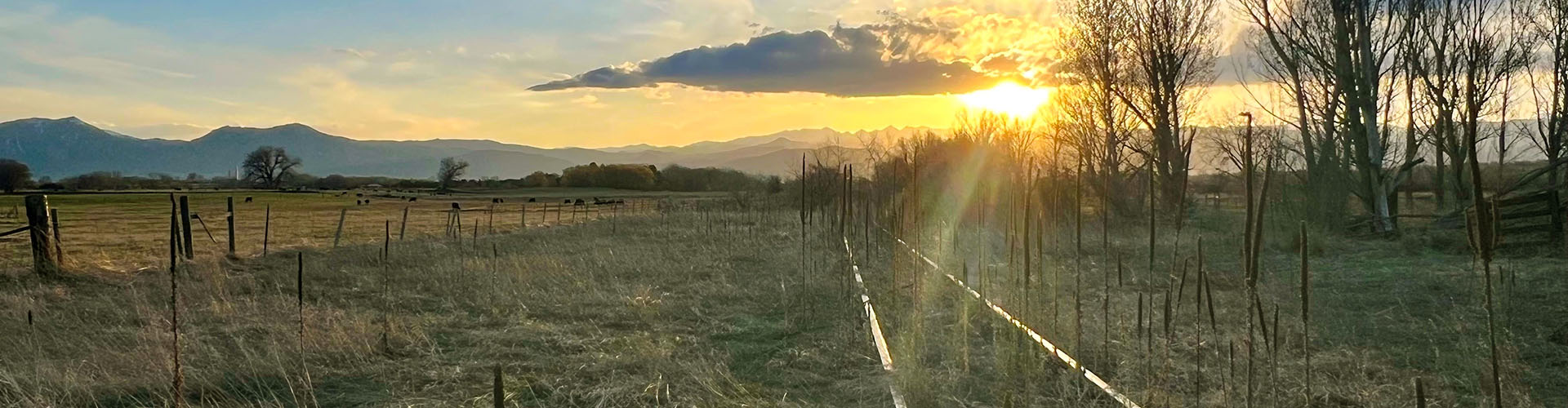
The Boulder to Erie Regional Trail (BERT) project will create a regional multi‑use connection between Boulder and Erie by converting a portion of the former Union Pacific rail corridor into an accessible trail.
Boulder to Erie Regional Trail (BERT)
The BERT connection was identified in the county’s regional trails prioritization process in 2003 and is eligible for funding through the Countywide Sales Tax. The Boulder County Comp Plan, Boulder Valley Comprehensive Plan, and Boulder County Transportation Master Plan identify this trail connection as an important link in the Boulder Valley and regional trails systems.
The first step in trail development is to conduct a master planning process to identify needs, opportunities, and constraints of constructing the regional trail. That process began in the spring of 2019 and the BERT Plan was approved by the Boulder County Board of Commissioners in October of 2024. The project is now entering the engineering design phase in the Fall of 2025. More information about project next steps will be posted here as it becomes available.
The BERT Plan
The BERT Plan evaluates multiple conceptual alignments and identifies a preferred alignment for further consideration for an east-west multi-use trail connection between the City of Boulder and Town of Erie. The BERT Plan includes the project process, public and stakeholder input and engagement, technical evaluation, conceptual level alignment, opinion of cost, and next steps.
Project Schedule
The Boulder to Erie Regional Trail (BERT) master planning process includes seven phases. The overall project began in the Spring of 2019 with an initial goal of planning process completion in 2021. The seven phases of the project are: Project Kick Off & Initial Data Collection, Potential Alignments Study, Additional Data Collection & Project Partnerships, Evaluation Criteria, Conceptual Alignments Evaluation, Select & Refine Conceptual Alignments for Further Consideration, and Final Master Plan.
The BERT project timeline was expanded in June of 2021 to address the need for additional analysis of environmental and wildlife impacts, consideration of additional route options outside the RTD rail corridor, and engagement with Native American tribes and community members.
In late 2022, since the additional route options for consideration outside the RTD rail corridor use City of Boulder-owned lands, the County and City of Boulder Open Space and Mountain Parks (OSMP) developed a Memorandum of Understanding to gain agreement on the process and additional route options.
Frequently Asked Questions (FAQs)
The County has convened a Steering Committee of County staff, City of Boulder (including OSMP), Town of Erie, Colorado Parks and Wildlife, and RTD. The County is also working with additional agencies as needed during the planning process, including the Mile High Flood District and Colorado Department of Transportation.
A primary goal of the project is to connect with both the Town of Erie and City of Boulder trail systems. These trail systems provide extensive connectivitiy to other regional trails.
The crossing of Hwy 287 is dependant on the preferred route chosen, but potential crossings could be an underpass within the RTD rail corridor, under the existing 287 bridge over Boulder Creek, and at the Isabelle signal.
The project team is committed to working with and understanding the perspectives of adjacent landowners. To date, the team has met with some landowners adjacent to the RTD rail corridor and held neighborhood workshops for neighbors within a quarter mile of the center line of the rail corridor. If additional adjacent landowners wish to be part of the process, please email the project team to set up a time to talk.
The project team will use existing data, including management area designations from both Boulder County and the City of Boulder, as well as individual species habitat and occurrence data from the Colorado Parks and Wildlife, the County, and the City to gain a general understanding of the species with habitat or potentially occurring within the project area. The project team will further refine this data and work with project partners (including the City and County staff) to identify more and less environmentally sensitive areas within the corridor based on environmental resources, conservation priorities, and permitting requirements. High level site visits along the corridor will also inform this process. The project team will then use this information to develop evaluation criteria to assess the various conceptual alignments.
Any conceptual trail alignments, or portions of alignments, that are located in the RTD Rail ROW will be planned as a “rail with trail” alignment. This means any outcome of this project will not preclude the ability for trains to run along the tracks of this corridor. At this time, we do not know of any plans by RTD to use the corridor for rail.
The project team is working with indigenous residents of Boulder County as well as tribal and nation leaders and representatives to understand the history and significance the project area may have for American Indian tribes and indigenous peoples.
Impacts to animal and plant species will vary depending on the trail alignment location. Common animal species found in the area include mule deer, fox squirrel, deer mouse, striped skunk, raccoons, black-billed magpie, and red-winged blackbird. Numerous native and non-native plant species occur in the area. Conceptual alignments within or near floodplains, wetlands, and streams could impact sensitive species including federal and state listed species, such as Preble’s meadow jumping mouse, black -tailed prairie dogs, Ute ladies’ tresses orchid, and several raptor species. The conceptual alignments along more developed upland areas would be less likely to impact sensitive animal and plant species. Impacts to all plant and animal species will be limited as much as possible through the master planning process.
The master planning process will define and analyze multiple conceptual alignments based on criteria developed in partnership with the Steering Committee, Community Working Group, and Native American Community Leaders. Some of the alignments will not be located in senstive environmental areas. For any conceptual alignments that are in areas of concern, this planning process will identify design, engineering, and mitigation requirements to limit any environmental impact.
Past Public Meetings and Documents
Four neighborhood workshops were held in the Spring of 2019
Community Working Groups
- Meeting #1 Presentation and Notes
- Meeting #2 Presentation and Notes
- Preliminary Alignment Alternatives Maps, August 2020
August Virtual Public Meeting
Open House in Erie – Sept. 13, 2023
An open house was held in Erie to provide an update on the BERT project. During this open house, the project team discussed project updates, evaluation criteria for different trail options, and conceptual alignments. View the BERT Public Meeting Presentation, Sept. 13, 2023
BERT Plan Appendices:
BERT Plan Survey and Summary Report:
- BERT Online Survey Summary Report – March, 2024
Open Space Board Presentations – BERT agenda item:
- Erie Open Space and Trails Advisory Board – Sept. 9, 2024
- City of Boulder Open Space Board of Trustees – Sept. 11, 2024
- Boulder County Parks & Open Space Advisory Committee – Sept. 26, 2024
Open House in Boulder – Sept. 29, 2024
At the Boulder to Erie Regional Trail (BERT) Project Open House held in Boulder, the team shared an overview of the project, the preferred alignment for further consideration, and opportunities to review and provide comments on the draft plan.
Board of County Commissioners (BOCC) Public Hearing – Oct. 24, 2024
On Thursday, October 24, the Boulder County Board of County Commissioners approved the Boulder to Erie Regional Trail (BERT) Plan in a 2-1 vote. Public testimony was taken during the hearing. Thank you to everyone who submitted written comments and spoke at the public hearing.
The BERT Plan evaluates multiple conceptual alignments and identifies a preferred alignment for further consideration for an 8.5 mile east-west multi-use trail connection between the City of Boulder and Town of Erie. The BERT Plan includes the project process, public and partner input and engagement, technical evaluation, conceptual level alignment, opinion of cost, and next steps.
With the adoption of the BERT Plan, local, state, and federal funding opportunities can be pursued, and the preliminary design process can begin. The plan’s preferred alignment is the starting point for more detailed engineering and in-depth technical analysis, including additional environmental analysis. We will also be looking at strategies to minimize potential environmental impacts of the preferred alignment.
Partner coordination and community outreach will continue in the next phases of the project. We will continue to provide regular updates as the project progresses.
View the video of the Oct. 24, 2024 Board of County Commissioners hearing, the staff report for Oct. 24, 2024, and additional public comments received.
Project Contact
Tonya Luebbert
Regional Trails Planner
720-564-2866
tluebbert@bouldercounty.gov


