Linking Boulder County is a vision and action plan to make public transit easier and more useful for people who live, work, and visit Boulder County. Transit includes buses operated by RTD, shuttles to parks and mountains, and shared vehicles like Ride Free Lafayette and paratransit. This plan is the first time Boulder County has set a countywide vision for transit, and it’s an important opportunity to better serve our community. Ultimately, Linking Boulder County will help public transit meet the needs of our growing county into the future.
Linking Boulder County: A Shared Vision for Transit

Get Involved
Over the last year, our team has been busy understanding transit needs and opportunities in Boulder County. We’ve gathered information by riding the bus, analyzing data, reviewing past plans, and hearing from more than 2,000 Boulder County residents. Thank you for sharing your feedback! Stay tuned for summaries of our past outreach activities and news about future activities.
Fall 2025 Outreach Findings
During our first round of community outreach, we asked you to share your transit needs and opportunities. More than 1,300 Boulder County residents, employees, and visitors provided feedback through our survey, pop-up events around the county, a virtual open house, and meetings of the Community Advisory Committees.
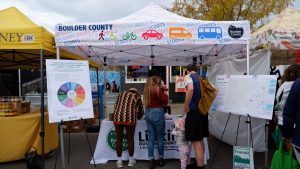
Although Boulder County communities are diverse—with distinct challenges, desires, and goals—people consistently expressed a need for improved transit frequency, reliability, comfort, and safety. Survey respondents also asked for more service to the airport, to local jurisdictions beyond the City of Boulder, and to trails and recreation in the mountains.
You can learn more about what we heard through the links below:
- Phase 1 Outreach Summary: Coming Soon!
- Linking Boulder Virtual Open House, Nov. 6, 2025
- Transporte Público Reunión a Puerta Abierta Virtual
Draft Transit Vision
The Linking Boulder County Transit Vision expresses what transit means to our community and what we hope it can do for Boulder County. The vision is informed by community and partner input, including our fall 2025 outreach. It was also shaped by time riding transit in Boulder County, as well as by past plans and our State of Transit Report, and considers the trends that will shape transit in the coming years.
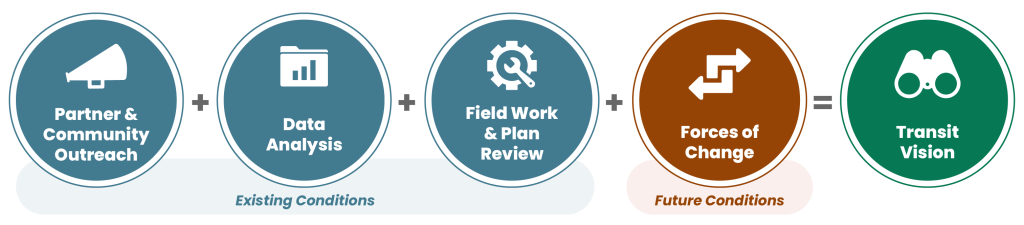
The draft Transit Vision includes a vision statement, goals, principles for improving transit, and a map of key connections. These elements will guide how we develop recommendations, and we want to be sure we have them right. You can learn more about the Transit Vision in the document below and take our short Transit Vision Survey to share your input before the end of May.
State of Transit In Boulder County
Did you know that people take 7.6 million trips on public transit in Boulder County each year? At the same time, less than 1% of trips entering and leaving the county were by public transit in 2024, half as many as there were in 2019.
Today, there are 12 providers who make transit possible in Boulder County, and they operate 54 different routes and services. Many parts of our county have access to transit, but there are gaps in both our more urban and more rural communities.
The State of Transit in Boulder County Report summarizes transit needs—including takeaways from the first round of community outreach—and existing conditions. The Briefing Book provides a quick overview of 15 key findings. If you want to dive deeper, the full report is for you!
Project Timeline
Linking Boulder County began in summer 2025 and will wrap up by the end of 2026. The graphic below shows our schedule and is followed by a description of the key activities.
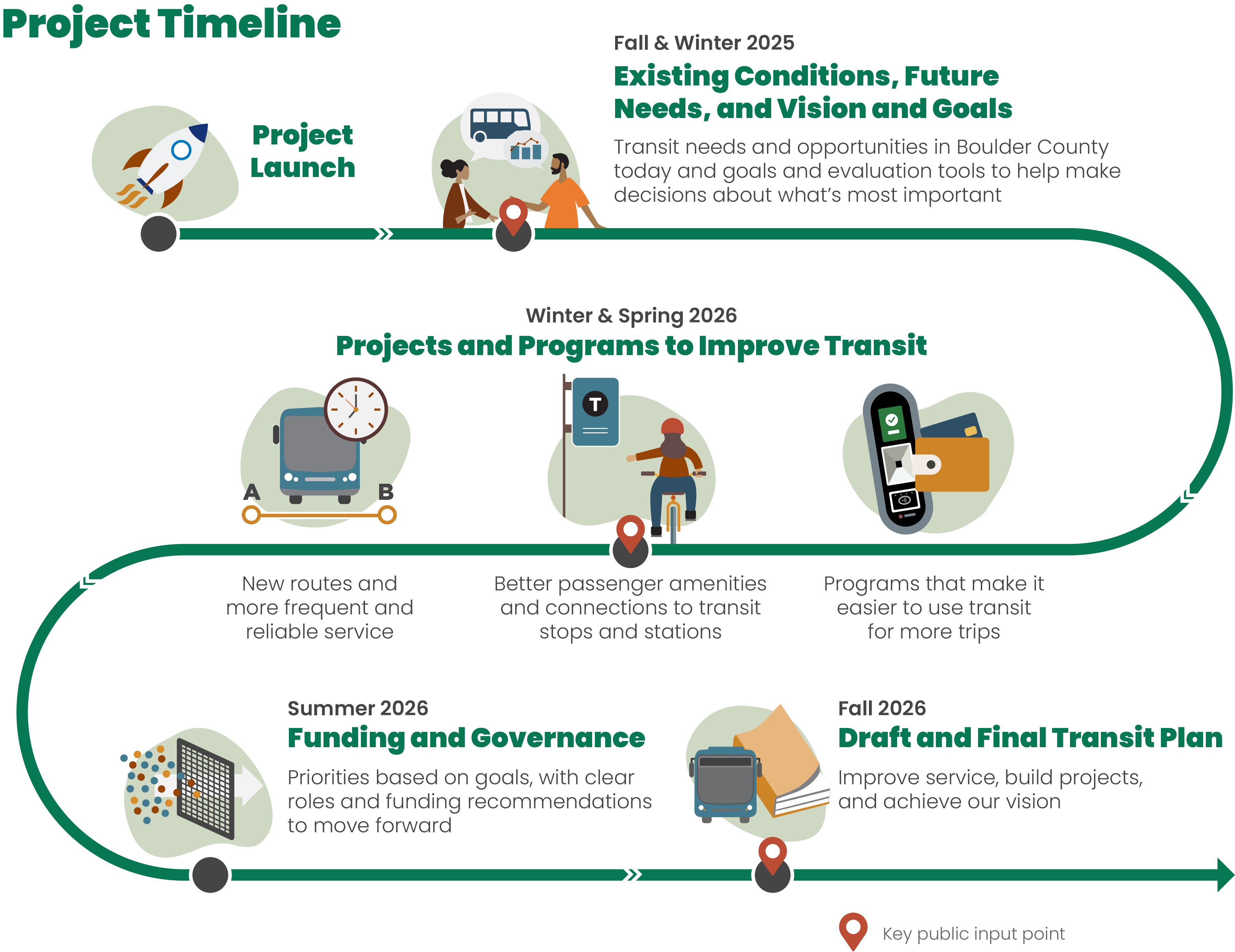
Timeline Details:
- Summer 2025 – Project Launch
- Fall and Winter 2025 – Existing Conditions, Future Needs, and Vision and Goals:
Transit needs and opportunities in Boulder County today and goals and evaluation tools to help make decisions about what’s most important - Winter and Spring 2026 – Projects and Programs to Improve Transit:
New routes and more frequent and reliable service; better amenities and connections to transit stops and stations; programs that make it easier to use transit for more trips - Summer 2026 – Funding and Governance:
Priorities based on goals, with clear roles and funding recommendations to move forward - Fall 2026 – Draft and Final Transit Plan:
Improve service, build projects, and achieve our vision
Advisory Committees
Four committees are informing Linking Boulder County: two Community Advisory Committees (CACs), a technical committee, and a policy committee. The two CACs—one English language and one Spanish language—were formed specifically for this project. The Subregional Forum Technical Advisory Committee and Subregional Forum are standing committees of our regional planning organization, the Denver Regional Council of Governments (DRCOG).
Committee Meetings and Materials
The English Language Community Advisory Committee (CAC) includes 15 members that represent communities and perspectives across Boulder County. The CAC helps our project team learn more about how people use current transit services, identify what’s needed in the future, and advise on priorities for residents, employees, and visitors.
Past Meeting Materials
-
- CAC Meeting Presentation, English and Spanish, July 2026
- CAC Meeting Presentation, March 2026
- CAC Meeting Presentation, October 2025
- CAC Meeting Presentation, December 2025
- CAC Meeting Summary, May 2026
- CAC Meeting Summary, March 2026
- CAC Meeting Summary, December 2025
- CAC Meeting Summary, October 2025
El Comité Asesor Comunitario en español (CAC) está compuesto por 15 miembros que representan diversas comunidades y perspectivas de todo el Condado de Boulder. El CAC ayuda a nuestro equipo del proyecto a conocer mejor cómo las personas utilizan los servicios de transporte actuales, identificar lo que se necesita en el futuro y asesorar sobre las prioridades para residentes, trabajadores y visitants.
The Spanish Language Community Advisory Committee (CAC) includes 15 members that represent communities and perspectives across Boulder County. The CAC helps our project team learn more about how people use current transit services, identify what’s needed in the future, and advise on priorities for residents, employees, and visitors.
Material de Reuniones
- Presentacion de CAC, Ingles y Español, Julio 2026
- Presentacion de CAC, Mayo 2026
- Presentacion de CAC, Marzo 2026
- Presentacion de CAC, Dic. 2025
- Presentacion de CAC, Oct. 2025
- Sumario de Reunion de CAC, Oct. 2025
- Sumario de Reunion de CAC, Dic. 2025
- Sumario de Reunion de CAC, Marzo 2026
- Sumario de Reunion de CAC, Mayo 2026
Forum members are local elected officials who provide direction to the project team, as well as input and expertise on proposed policy solutions. The Forum is part of DRCOG’s Boulder County Subregional Forum. Learn more about the Forum, current members, and how to attend and participate in meetings:
Past Meeting Materials
The Forum TAC provides input and expertise on proposed technical solutions for Linking Boulder County. The Forum TAC is part of DRCOG’s Boulder County Subregional Forum. Learn more about the committee, current members, and how to attend and participate in meetings:
Past Meeting Material
- Forum TAC Presentation, March 2026
- Forum TAC Presentation, June 2026
- Forum TAC Presentation, Dec. 2025
- Forum TAC Presentation, July 2025
- Forum TAC Presentation, April 2026
- Forum TAC LBC Revenue Sources Presentation, Sept. 21, 2026
- Forum TAC Meeting Agenda, Sept. 21, 2026
- Forum TAC Meeting Summary, Sept. 21, 2026
Frequently Asked Questions (FAQ)
Linking Boulder County is a vision and action plan to make public transit—like buses, shuttles, trains, and similar shared vehicles—easier and more useful for people who live, work, and visit Boulder County. This plan is the first time we’ve set a countywide vision for transit, and it’s an important opportunity to better serve our community. Ultimately, Linking Boulder County will help public transit meet the needs of our growing county into the future.
Linking Boulder County is led by Boulder County in coordination with local jurisdictions and community partners. The County team is supported by a consultant team with a mix of local and national experience.
Our county is growing, and we need to make sure transit keeps up so people have more options to travel efficiently and safely. We want an equitable, sustainable, and affordable transit system that keeps up with our growth.
Additionally, our transit network needs an update. The system was designed for commuting to work, but current travel patterns go beyond getting to a job. We all travel to many different types of places, and so should our transit system.
Linking Boulder County relies on public input to create a transit vision that truly works for everyone. Your input will inform and guide many parts of the project, including helping us understand travel needs, shaping the project goals, and developing strategies to improve transit in the county.
Linking Boulder County will look at many strategies to improve transit. We’ll consider changes to the existing bus service, new routes or types of services, and better connections to transit, such as bikeshare programs. We’ll also explore projects to improve stops and stations and programs or policies that encourage people to use transit.
Absolutely! Linking Boulder County looks at the whole county—our rural and mountain communities also need high-quality transit options.
Linking Boulder County will engage people of all ages and abilities to understand their needs. The recommendations will help to ensure our transit system is available to everyone.
Funding for Linking Boulder County is provided by a grant from the Denver Regional Council of Governments (DRCOG), with a local match paid for by Boulder County.
More Information
Linking Boulder County comes on the heels of mobility planning efforts across the county. Below is a list of related plans for the transit enthusiasts among us:
- Boulder County Mobility and Access for All Ages and Abilities: Guides multimodal transportation policy for populations with special needs.
- Boulder County Transportation Master Plan: Outlines a vision for a safe, accessible, and sustainable multimodal transportation system.
- City of Boulder Transportation Master Plan: Recommends expanded local and regional transit connections to the City of Boulder.
- Erie Transportation Mobility Plan: Discusses regional transit, mobility hubs, and transit supportive amenities and policies.
- Lafayette Multimodal Transportation Plan: Envisions connecting regional destinations with transit, improving service frequency and reliability, and providing service for all.
- Louisville Transportation Master Plan: Proposes a transit network, as well as improved transit access and amenities.
- Nederland Multimodal Transportation Plan: Envisions expanding regional transit, implementing intra-county transit, and upgrading bus stops.
- Longmont Transportation Mobility Plan: Aims to continue microtransit operations, upgrade stop amenities, and support local and regional transit investments.
- Superior Transportation Plan: Prioritizes increased bus frequency and better connections to transit through bike facilities and park and rides.
We avoid transit jargon whenever possible, but you may come across unfamiliar terms in Linking Boulder County documents or other related materials. Here’s a list of common terms, and we’ll add to it as we go:
- Capital projects: Larger, long-term investments in facilities and equipment for transit, such as building new signals, bus lanes, and transit centers.
- Circulator service: Transit service confined to a specific area, such as a downtown or a suburban neighborhood, with connections to major corridors.
- Commuter service: Transit service designed to carry people to and from work or school, typically with more service during peak morning and evening hours.
- First/last mile: How transit riders get to and from transit stops and stations, including walking and rolling, biking, driving, or other modes of travel.
- Fixed-route service: Transit that runs on a set schedule along the same path with designated stops.
- Headway: The interval of time between scheduled arrivals of a bus on a particular transit route (e.g., 15 minutes).
- Microtransit: A shuttle service that can be on-demand (in real-time) or fixed with frequent updates. Shuttles often operate where fixed-route service is unavailable.
- Mobility hub: A transit stop or station area with access to a variety of transportation modes including pedestrian, bicycle, and shared mobility options.
- On-demand service: Transit service that can be requested when you need it and scheduled through an app, website, or phone call. Vehicles pick you up and drop you off at your requested location.
- Service frequency: The number of buses per hour that serve a particular transit route (e.g., 4 buses per hour).
Project Manager
Alex Hyde-Wright
Regional Multimodal Planning Division Manager
ahyde-wright@bouldercounty.gov