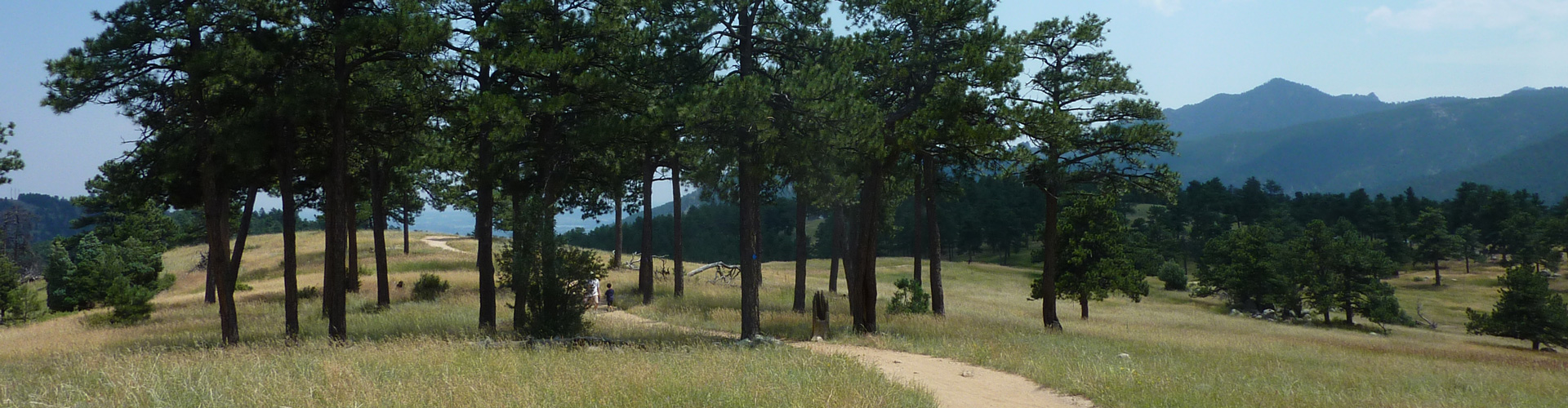
Betasso Preserve is a favorite foothills destination. It offers mountain views, views of the golden plains, scenic trails, and diverse habitats. The preserve also has a rich history.
Betasso Preserve
Trails
-
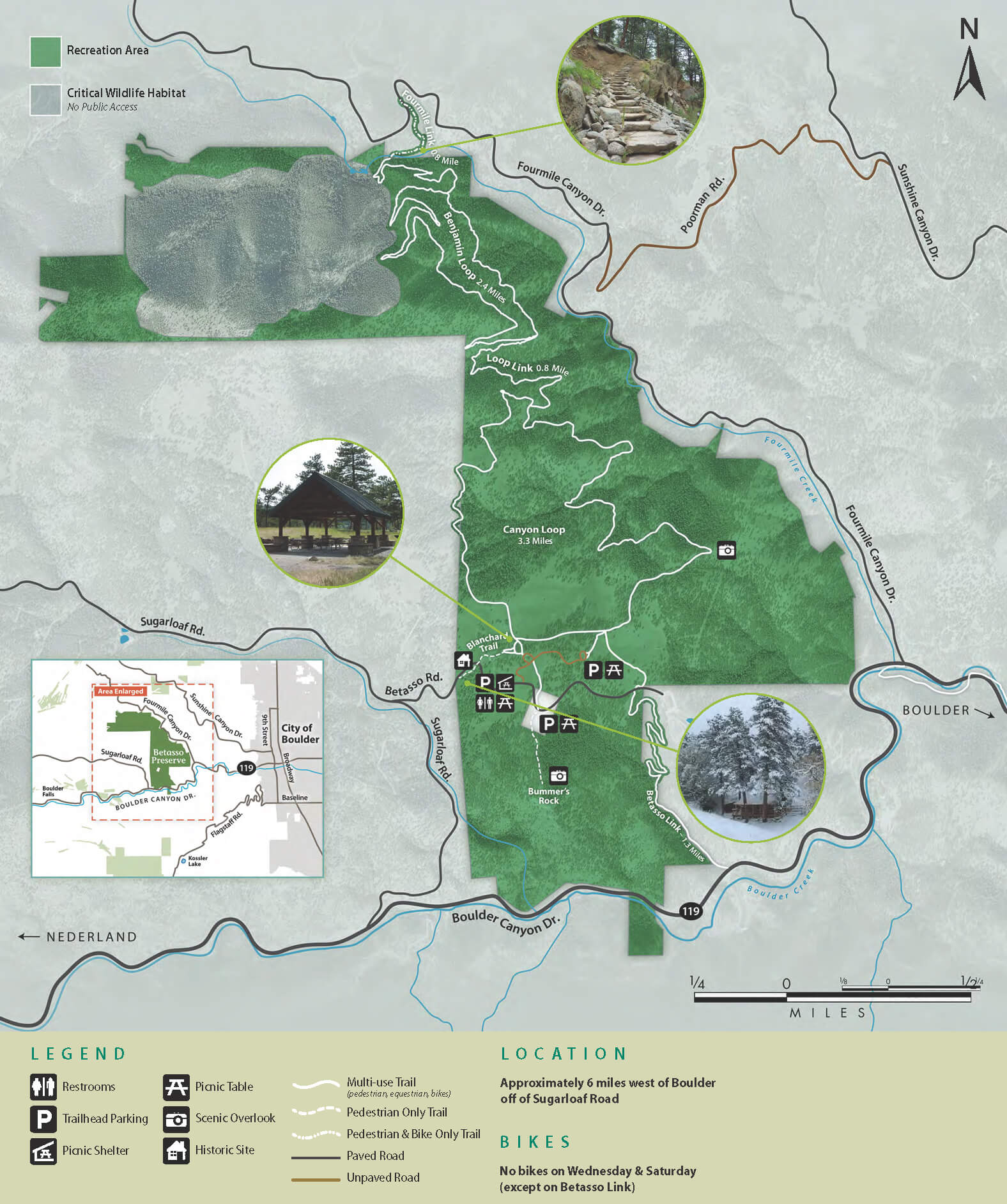
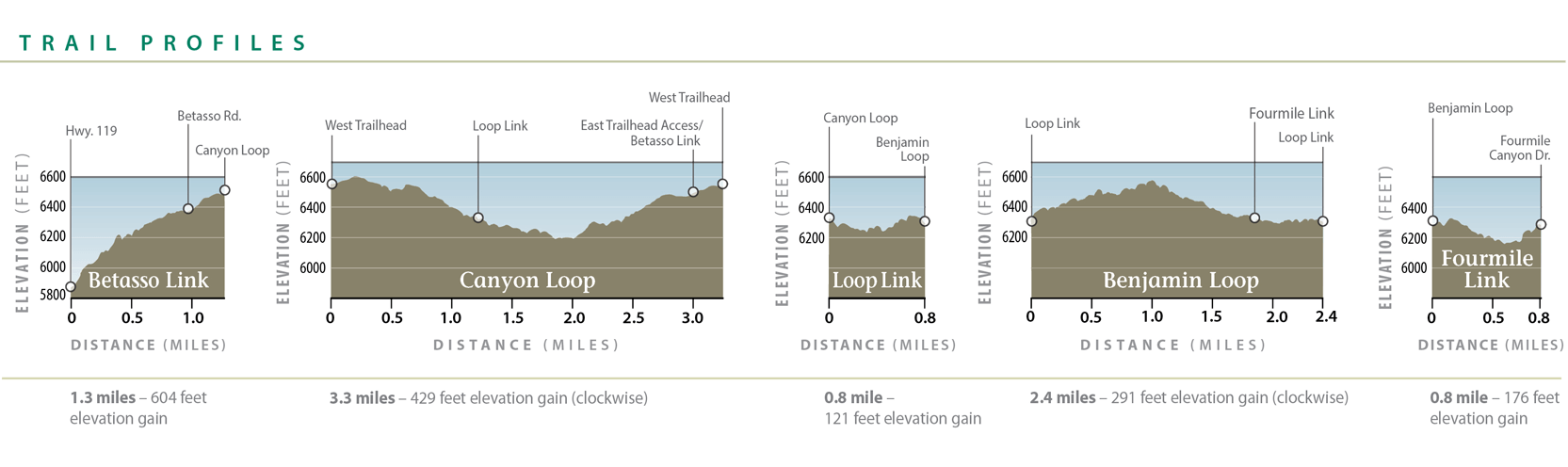
Betasso Link
1.3 miles – Difficult


-
Canyon Loop
3.3 miles – Moderate/Difficult
Bike Direction: Counterclockwise
Bikes prohibited Wednesdays and Saturdays -
Loop Link
0.8 miles – Moderate
Bikes prohibited Wednesdays and Saturdays -
Benjamin Loop
2.4 miles – Moderate
Bike Direction: Counterclockwise
Bikes prohibited Wednesdays and Saturdays -
Fourmile Link
0.8 miles – Moderate
Horses can only access from the Benjamin Loop due to steep terrain and stairways
Bikes prohibited Wednesdays and Saturdays -
Blanchard Trail
0.3 miles – Moderate
This is a short trail made up of 177 steps that lead to the Blanchard Cabin 

-
Bummer’s Rock Trail
0.3 miles – Moderate
Regulations

Day Use Only

Pets On Leash

Bikes On Designated Trails Only

No Electric Rideables

No Open Fires

No Hunting/Firearms

No Camping
Trailhead Amenities

44 car parking spots across 3 parking lots

2 ADA parking spots (1 van accessible)

Restroom near main trailhead

Several picnic tables located near parking lots

Large 50-person group shelter located near main trailhead Shelter Reservation Info

Horse trailer parking available at Bummer’s Rock Trailhead
Keep in Mind
- Hikers and equestrians are encouraged to visit on Wednesdays and Saturdays when bikes are not allowed.
- Hiking, horseback riding, and dog-walking (on leash) are allowed on all trails.
- Please share the trail and follow trail etiquette.
- The Benjamin Loop trail is steep and narrower than 3-feet wide. This makes it especially challenging for novice equestrians and mountain bikers.
- Equestrians can only reach the Fourmile Link trail from the Benjamin Loop. The section between Fourmile Creek and Fourmile Canyon Drive has steep terrain and stairways. Watch a video of this section.
- E-bikes, electric unicycles, hoverboards, Onewheels, Segways, and similar electric devices are not allowed.
Photos
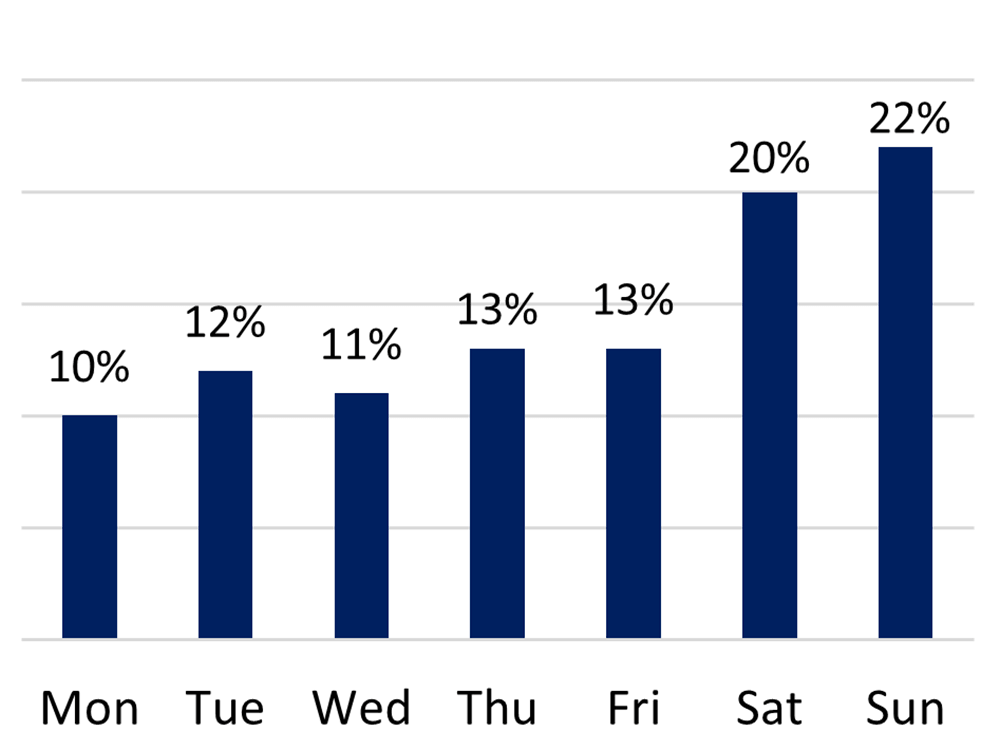
Open Gallery in New WindowVisitation by Day of the Week
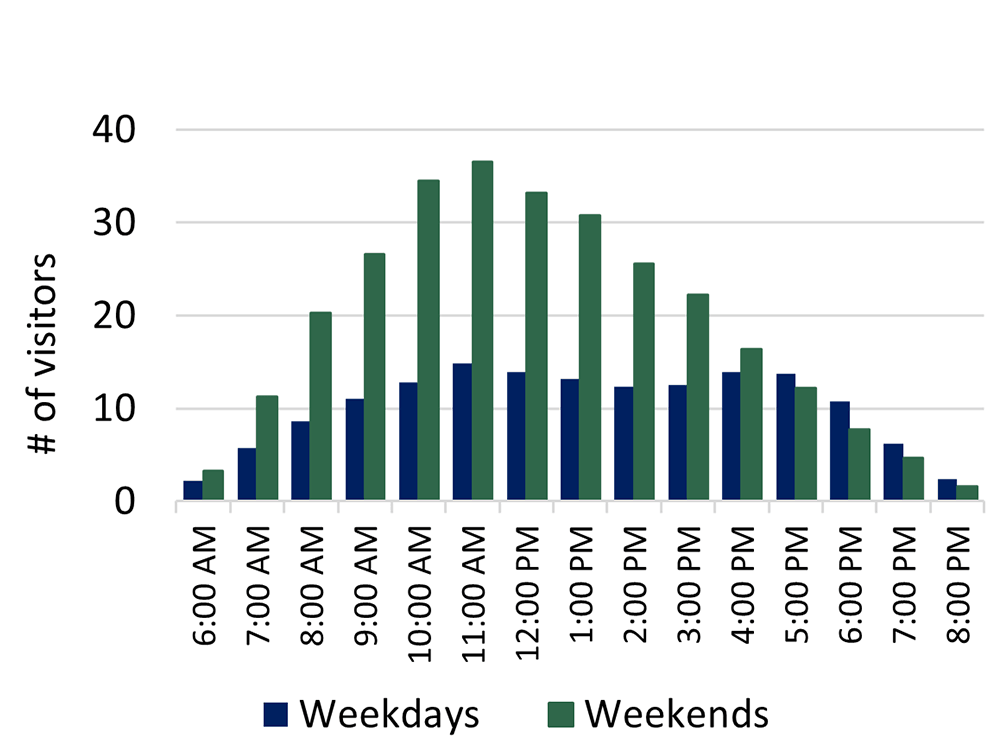
Visitation by Hour
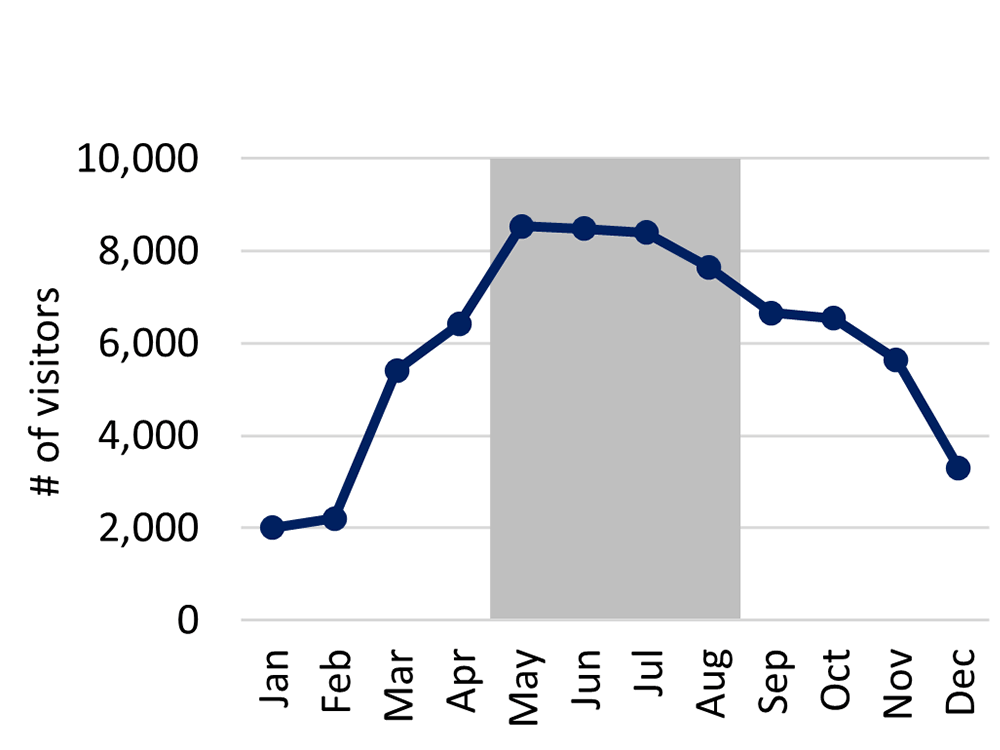
Visitation by Month
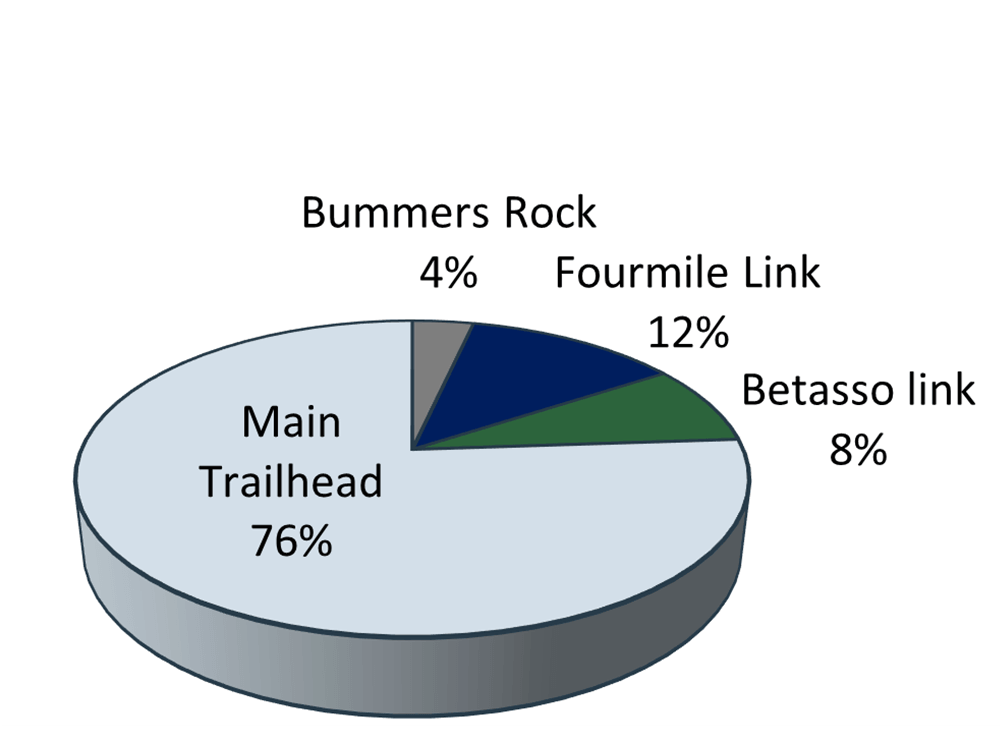
Visitation by Location
Along Colorado’s Front Range, the grasslands of the Great Plains rise to meet the peaks of the southern Rocky Mountains. Where they meet, you find the foothills. This area marks a transition zone between two very different landscapes. Foothills ecosystems include cliffs, canyons, hills, and meadows.
Betasso Preserve covers 1,151 acres. Its plant communities range from grasslands to shrublands to forests. These habitats support a wide variety of wildlife.
Mammals
- Abert’s squirrel
- Black bear
- Bobcat
- Coyote
- Least chipmunk
- Little brown bat
- Mountain lion
- Mountain vole
- Mule deer
- Nuttall’s (mountain) cottontail
- Northern pocket gopher
- Red fox
- Rock squirrel
- Striped skunk
Birds
- American crow
- American kestrel
- American robin
- Black-billed magpie
- Broad-tailed hummingbird
- Chipping sparrow
- Common nighthawk
- Common raven
- Cooper’s hawk
- Dark-eyed junco
- Downy woodpecker
- Mountain bluebird
- Mountain chickadee
- Mourning dove
- Northern flicker
- Plumbeous vireo
- Pygmy nuthatch
- Red-tailed hawk
- Steller’s jay
- Turkey vulture
- Violet-green swallow
- White-breasted nuthatch
- Wild turkey
- Western tanager
Reptiles
- Bullsnake
- Eastern fence lizard
White Wildflowers
- Mouse ear chickweed (Cerastium spp)
- Nodding onion (Allium cernum)
- Porter aster (Aster porteri)
- Pussytoes (Antennaria sp)
- Western white clematis (Clematis ligusticifolia)
- Yarrow (Achillea lanulosa)
Yellow Wildflowers
- Blanket flower (Gaillardia aristata)
- Golden banner (Thermopsis divaricarpa)
- Goldenrod (Solidago sp)
- Gumweed (Grindelia squarrosa)
- Heart-leaf arnica (Arnica cordifolia)
- Hairy false golden aster (Heterotheca villosa)
- Little sunflower (Helianthus pumilus)
- Sulphur flower (Eriogonum umbellatum)
- Western wallflower (Erysimum asperum)
- Whiskbroom parsley (Harbouria trachypleura)
- Yellow evening primrose (Oenothera sp)
- Yellow stonecrop (Amerosedum lanceolatum)
Pink, Orange & Red Wildflowers
- Fairy trumpet – Scarlet gilia (Ipomopsis aggregata)
- Spotted coralroot (Corallorizha maculata)
- Wild geranium (Geranium caespitosum)
Purple & Blue Wildflowers
- Common harebell (Campanula rotundifolia)
- Fireweed (Chamerion angustifolium)
- Greenleaf (low) penstemon (Penstemon virens)
- Larkspur (Delphinum nelsoni)
- Lanceleaf chiming bells (Mertensia lanceolata)
- Mountain larkspur (Delphinium ramosum)
- One-sided penstemon (Penstemon secundiflorus)
- Pasqueflower (Pulsatilla patens)
- Smooth aster (Aster laevis)
- Tall chiming bells (Mertensia ciliata)
- Western spiderwort (Tradescantia occidentalis)
Green Wildflowers
- Fringed silver sage (Artemisia frigida)
- White sage (Artemisia ludoviciana)
Shrubs
- Kinnikinnick
- Oregon grape
- Prickly rose
- Yucca
Trees
- Aspen
- Common juniper
- Douglas fir
- Ponderosa pine
Boulder Creek granodiorite forms the base of Betasso Preserve. This is one of the oldest rock types in Boulder County. Molten material formed this rock long ago. The material cooled and hardened slowly, then pushed upward.
The mountains in this area have risen and eroded several times. Each time, wind and water wore the mountains down to low hills or flat plains. About 65 million years ago, a mountain-building period called the Laramide uplift began. It formed tall peaks and created rich mineral deposits, including gold and silver.
Today, erosion continues to shape Betasso Preserve. Each spring, melting snow feeds streams that carve and reshape the landscape.
Homesteading, Mining, and Ranching
In the 1870s, sawmills and mining operations opened along Boulder and Fourmile canyons. The town of Orodell grew where these two canyons meet, next to what is now Betasso Preserve. Orodell had a general store, a post office, and a school. Five stagecoaches passed through town each day, traveling between Boulder and Nederland. A fire destroyed most of Orodell in 1883. A flood destroyed the sawmill and gold mill in 1894. Neither was rebuilt.
Eighteen years passed before anyone homesteaded the land above Orodell, now Betasso Preserve. In 1912, the Blanchard family homesteaded 160 acres. In 1915, Steve Betasso, a hard rock miner from Fourmile Canyon, bought this small ranch. Steve and his sons, Dick and Ernie, expanded the ranch using profits from gold and tungsten mining. Dick and Ernie ran a cattle operation on the ranch. They kept cattle on the ranch through winter, then drove the herds to Mammoth Basin each summer to graze on high-country rangeland.
Boulder County’s First Open Space Purchase
In 1976, Boulder County bought 712 acres of the ranch from Ernie Betasso. Ernie wanted others to enjoy the land as he had. Until his death in 1983, Ernie helped the county manage Betasso Preserve.
The county later bought more land, including the 391-acre Benjamin Property in 2007. Betasso Preserve now totals 1,181 acres, enjoyed by both people and wildlife.