To receive this information in another language, please email commissioners@bouldercounty.gov
In Colorado, counties administer many essential safety net programs, such as food assistance (SNAP), child care assistance (CCAP), Temporary Assistance for Needy Families (TANF), and Medicaid. Many of these benefits are funded by the federal government and state government.
Increasingly, the federal funding for these public benefits is at risk. The State of Colorado was recently informed through letters from the federal government that some of this funding may be frozen. While benefits and services currently remain unchanged, these letters are politically motivated, and they promote a false narrative about fraud that threatens essential services for our most vulnerable community members.
We want to be clear: Boulder County Human Services administers these federally regulated benefits and entitlement programs so that only eligible households receive benefits. Our goal is always to deliver benefits accurately, fairly, and on time to people who qualify.
Our eligibility teams receive extensive training from state-certified trainers. Eligibility is based on federal and state rules, not county discretion. Our staff verify information, such as citizenship, employment, and income, using multiple trusted systems to ensure each decision meets legal requirements. The system is complex and our trained staff help guide families through the process.
Why do public benefits matter?
Public benefits help everyone. They reduce poverty, improve health, support education and employment, and lower long-term health care costs. They support economic stability by helping families meet basic needs like food, housing, health care, and child care. When people have a stable foundation, they can work, pursue education or training, and contribute more fully to their communities. Public benefits also strengthen local economies because families spend them quickly and locally on essential needs.
During the recent federal government shutdown, we heard misconceptions about who uses public benefits. Many people don’t realize that most people receiving food assistance through SNAP are children or adults over the age of 60, or that 85% of SNAP families have at least one working person in their household.
Programs like TANF and CCAP play a critical role for families with young children. TANF provides temporary cash assistance and employment support when families face job loss, illness, or other crises, and is only available for a limited amount of time. CCAP helps parents afford child care while they work or attend school. Without child care support, many parents — especially single parents — are forced to choose between employment and caring for their children.
Public benefits are an investment — helping people weather hard times, stay connected to work, and build toward long-term stability. When people are supported, entire communities are stronger.
As we said at the beginning of 2025, we believe that we all do better when we all do better. We are all better off when our community has stable housing, knows where their next meal is coming from, and can plan for their future.
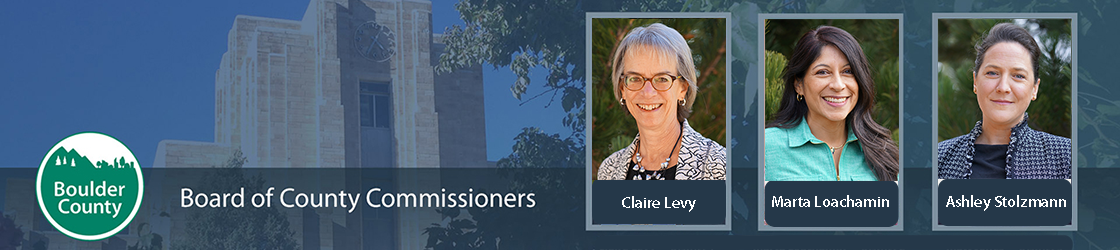
Commissioner Claire Levy
Commissioner Marta Loachamin
Commissioner Ashley Stolzmann
To find out more about public benefits, visit Boulder County’s website.
- Visit the County Commissioners' webpage
- View the Commissioners' Meeting Documents and Records
- Email the Board of County Commissioners
Americans with Disabilities Act Notice
Special Assistance
Boulder County wants to ensure that everyone has equal access to our programs, activities, and services. To request an Americans with Disability Act (ADA) accommodation, please email the ADA Coordinator at ada@bouldercounty.gov, or call 303-441-1386. Submit your request as early as possible, and no later than two business days before the event. Review the Boulder County's ADA Policy