

December 9, 2025
Grant programs to support nature-based climate solutions now accepting applications
Funding available for soil health, sustainable agriculture, and urban greenspace projects
To receive this information in another language, contact Emily Sandoval at esandoval@bouldercounty.gov.
Key Points
- Boulder County is launching three climate grant programs in December.
- Each grant program supports nature-based climate solutions.
- Projects will improve soil health, provide fresh food, and cool urban areas.
- Applications for the Soil Health Initiative, Grey to Green Fund, and Sustainable Food and Agriculture Fund are available on the Boulder County grants website.
Boulder County, CO — Boulder County is launching three grant programs in December to support nature-based climate solutions: the Soil Health Initiative, Grey to Green Fund, and Sustainable Food and Agriculture Fund. These programs will help local organizations and food producers implement projects that improve soil health, enhance urban green spaces, and strengthen the local food system.
“Boulder County is known for its open space and agricultural lands, which are key to addressing climate change,” said Commissioner Ashley Stolzmann. “Healthy soils and improved urban landscapes help us reduce emissions and build resilience to drought. These three grants allow us to partner with leaders across the county who are advancing nature-based solutions.”
Soil Health Initiative
The Soil Health Initiative supports farmers and ranchers who choose to improve soil health and promote a local, sustainable, and resilient food system. Projects must align with USDA soil health principles, such as minimizing soil disturbance, maximizing soil cover, increasing plant diversity, and incorporating livestock. Up to $660,000 in grants are available.
The Soil Health Initiative application for private lands opened on Dec. 8 and will close on Wednesday, Jan. 7, 2026. Farmers and ranchers operating on Boulder County-owned land will apply through a separate application that will open later in December.
Boulder County restaurants and food businesses are key partners in the Soil Health Initiative, contributing up to $100,000 in grants through Boulder County’s non-profit partner, Zero Foodprint (ZFP). ZFP works with local businesses to fund regenerative farming practices. By adding just a few cents to each purchase, customers at participating restaurants, bars, distilleries and other food and beverage businesses directly support projects like cover cropping, compost application, and reduced tillage—practices that enhance soil health, water retention, and climate resilience.
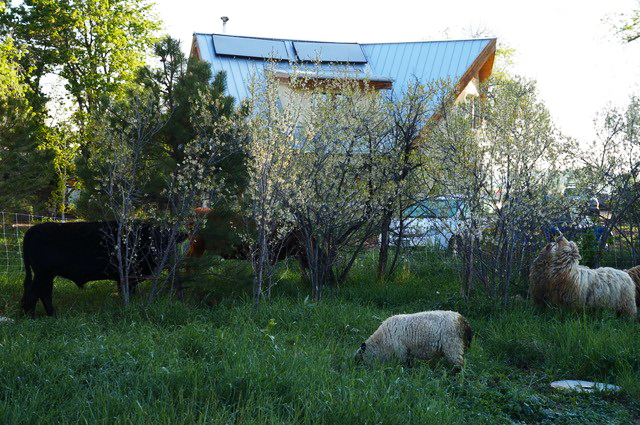
2025 grant recipient Karel Starek says that the Soil Health Initiative grant has helped his farm, The Golden Hoof, move its soil health forward exponentially. “It has allowed us to focus on planting silvopasture trees in our ruminant pastures and alley cropping plants in our bird gardens which over time will create greater diversity, healthier soil, year-round forage chains, shared wildlife and domestic animal habitat, summer shade, winter shelter, pollinator habitat, greatly reduced summer heat stress and water needs; the list goes on.” Photo courtesy of Golden Hoof Farm.
Grey to Green Fund
The new $100,000 Grey to Green Fund will support projects that replace “grey” features, like parking lots and pavement, to “green” features, like rain gardens and micro-forests. Awards will range from $20,000 to $50,000.
“Urban areas in the county face unique climate risks like extreme heat, flash flooding, and less variety of plants and animals,” said Boulder County Natural Climate Solutions Specialist Dede Croissant. “By replacing paved areas and working with nature, we can make our cities healthier and more livable.”
The Grey to Green Fund online application opens on Tuesday, Dec. 9 and will close on Tuesday, Feb. 3, 2026. Funding is available to municipalities, businesses, homeowners associations, non-profit organizations, and schools.
Boulder County will host an informational webinar about the Grey to Green Fund on Tuesday, Dec. 16 from 11:30 a.m. to 12 p.m. To attend the informational webinar about the Grey to Green Fund, register online.
Sustainable Food and Agriculture Fund
The $50,000 Sustainable Food and Agriculture Fund supports Boulder County organizations to make Boulder County’s food system more sustainable, including education and workshops, market infrastructure, sustainable food and crop processing, and resources for frontline farm workers and organizations.
The Sustainable Food and Agriculture Fund online application opened on Dec. 8 and will close on Wednesday, Jan. 7, 2026. Any registered business, official non-profit organization, or government entity can apply for funding. Grants will range from $10,000 to $25,000.
About the Sustainability Tax
In 2019, Boulder County voters approved a 15-year extension of the Sustainability Tax, a 0.125% sales and use tax that funds local sustainability initiatives through 2034.
About Zero Foodprint
This grassroots model ensures the benefits stay local, fostering healthier soils and sustainable agriculture in the same communities served by these businesses. For a list of participating restaurants and food businesses, visit the Zero Foodprint Member Directory. ZFP businesses and donors have utilized over $233,000 for healthy soil projects over the past two years. Zero Foodprint recently announced an innovative new partnership with fellow non-profit Sound Future and Colorado-based band, The Lumineers, who have committed 50 cents from each ticket sold on the US leg of their world tour for regenerative agriculture projects.
Mission of the Office of Sustainability, Climate Action & Resilience
Our mission is to advance policies and programs that conserve resources, protect the environment, and safeguard our climate in order to build a sustainable, just, and resilient community.