Project Updates
Trail connections near the Rocky Flats National Wildlife Refuge have been completed. More information can be found on the Rocky Mountain Greenway page managed by Jefferson County.
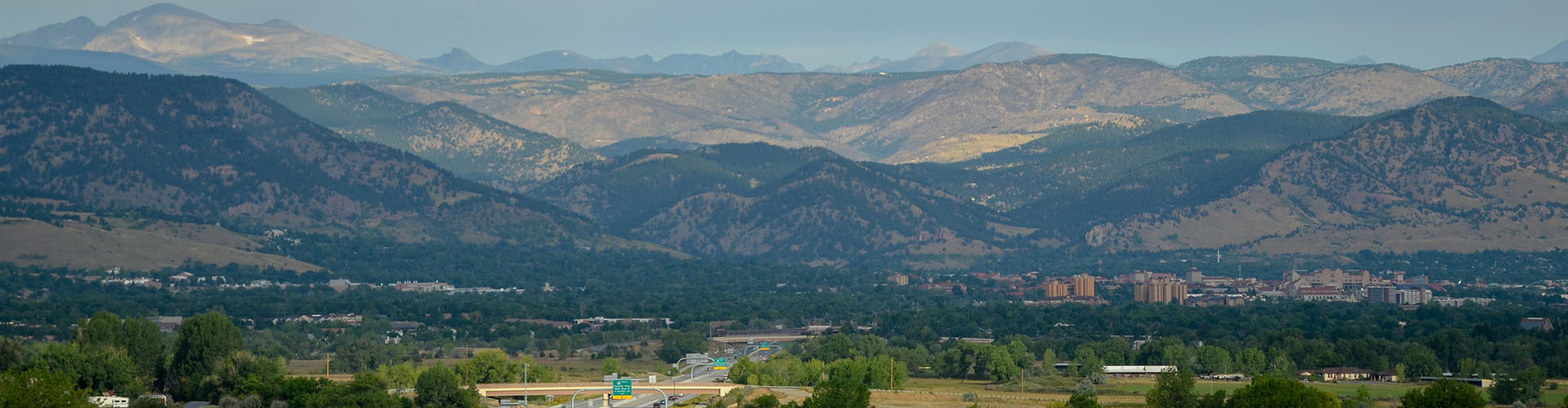
Trail connections near the Rocky Flats National Wildlife Refuge have been completed. More information can be found on the Rocky Mountain Greenway page managed by Jefferson County.
In response to requests from members of the public for additional signage, the Boulder County Commissioners gave direction to Boulder County Parks & Open Space staff to install a sign near the newly constructed underpass that connects Coalton Trail to the trails at Rocky Flats National Wildlife Refuge. The sign was installed on Dec. 22, 2025, near the terminus of the Coalton Trail at Highway 128.
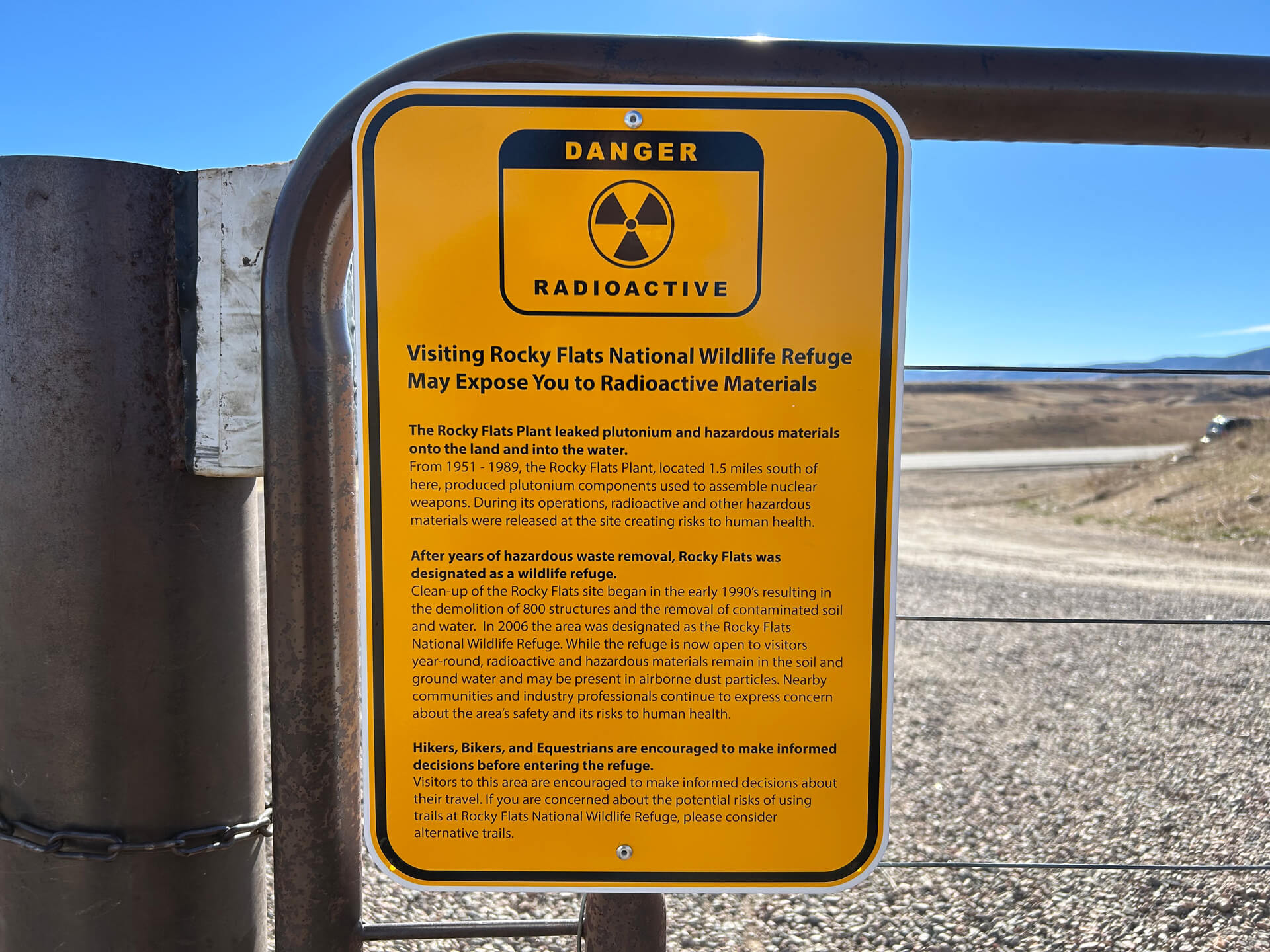
Danger Radioactive
Visiting Rocky Flats National Wildlife Refuge May Expose You to Radioactive Materials
The Rocky Flats Plant leaked plutonium and hazardous materials onto the land and into the water.
From 1951 – 1989, the Rocky Flats Plant, located 1.5 miles south of here, produced plutonium components used to assemble nuclear weapons. During its operations, radioactive and other hazardous materials were released at the site creating risks to human health.
After years of hazardous waste removal, Rocky Flats was designated as a wildlife refuge.
Clean-up of the Rocky Flats site began in the early 1990’s resulting in the demolition of 800 structures and the removal of contaminated soil and water. In 2006 the area was designated as the Rocky Flats National Wildlife Refuge. While the refuge is now open to visitors year-round, radioactive and hazardous materials remain in the soil and ground water and may be present in airborne dust particles. Nearby communities and industry professionals continue to express concern about the area’s safety and its risks to human health.
Hikers, Bikers, and Equestrians are encouraged to make informed decisions before entering the refuge.
Visitors to this area are encouraged to make informed decisions about their travel. If you are concerned about the potential risks of using trails at Rocky Flats National Wildlife Refuge, please consider alternative rails.
In 2016, the City of Arvada, City of Boulder, Boulder County, City and County of Broomfield, Jefferson County, and City of Westminster submitted a grant to extend a regional trails project, referred to as the Rocky Mountain Greenway (RMG). The grant supports the creation of underpasses at Indiana Street and Hwy128 that would ultimately connect trails in Broomfield’s Great Western Open Space into Boulder County. The Greenway Steering Committee will determine if the trail connection will go through Rocky Flats National Wildlife Refuge or near the refuge in order to make the connection between Broomfield and Boulder counties.
The overall vision of the project is to ultimately connect the three Front Range National Wildlife Refuges (Rocky Mountain Arsenal, Two Ponds, and Rocky Flats) with Rocky Mountain National Park through an interconnected, multi-use, regional trail system.
Prior to beginning the construction of the project, the governments independently procured a contractor to conduct soil analysis in the areas of the proposed trail crossings.
Soil sampling efforts in and around the Rocky Flats National Wildlife Refuge were conducted: sampling related to the Jefferson Parkway along the Indiana Street right of way, sampling within the Refuge where new trail construction will take place, and sampling related to the FLAP grant and the access facilities planned to connect the Rocky Mountain Greenway trail to the Refuge.
With respect to the FLAP grant sampling effort, the final report is available With respect to the FLAP grant sampling effort, view the final report.
The Rocky Mountain Greenway is a Colorado the Beautiful statewide priority trail project that has been designated by former President Barack Obama as an official project of America’s Great Outdoors.
The vision of the project is to ultimately connect the three Front Range National Wildlife Refuges (Rocky Mountain Arsenal, Two Ponds, and Rocky Flats) with Rocky Mountain National Park through an interconnected, multi-use, regional trail system.
From 1952-1989 the Rocky Flats Nuclear Weapons plant produced cores from plutonium, highly-enriched uranium, beryllium, and other materials as a secret U.S. Atomic Energy Commission facility. On June 25, 1989, the FBI and Environmental Protection Agency raided the U.S. Department of Energy’s plant for suspected environmental crimes. Rocky Flats was closed following the raid, the site was designated as a superfund site and a 10-year, $7 billion clean-up was completed in 2005 was completed in 2005. The 1,300 acres that comprised the production site are referred to as the “Central Operating Unit,” and remain under management of the Department of Energy as a Legacy Site – this site is not open to the public.
Through the Rocky Flats Act of 2001, the 5,237 acre “buffer area” surrounding the Legacy Site was designated as a National Wildlife Refuge. Though the land designated for the Rocky Flats Refuge was determined to be safe for residential use by the EPA and Colorado Department of Public Health and the Environment, the designation of the site as a wildlife refuge ensures that area will not be developed for residential use.
Boulder County is one of 10 local government members of the Rocky Flats Stewardship Council, along with three community organization members, and one individual. The Rocky Flats Stewardship Council was formed in 2006 to provide on-going oversight of the post-closure management of the Rocky Flats site.
Prior to 2006, Boulder County was a member of the Rocky Flats Coalition of Local Governments, which consisted of each of the seven local governments that border the Rocky Flats site or that own open space adjacent to the site. The intergovernmental agreement was created to work collaboratively with the community to ensure the U.S. Department of Energy’s clean-up of the Rocky Flats site was protective to human health and the environment.
For information regarding the Rocky Flats National Wildlife Refuge itself and public access, please contact the U.S. Fish and Wildlife Service.