Background
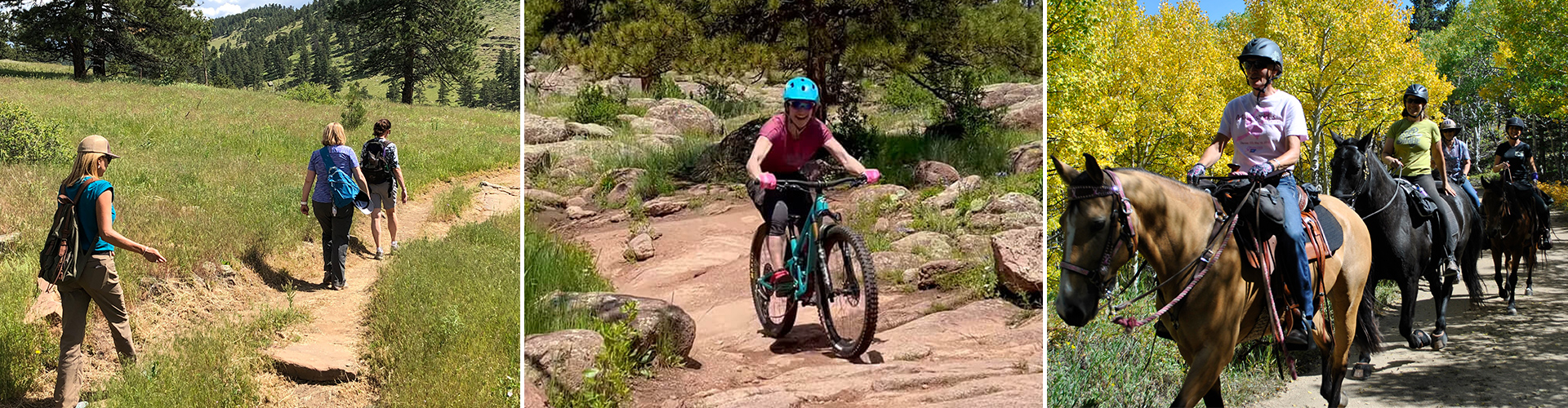
Boulder County explored a community-informed pilot program that would have tested alternating usage on select trails to potentially improve safety and enhance the experience for users. The pilot would have temporarily assigned specific days or times for different users (hikers, bikers, equestrians) instead of having all activities allowed at the same time.
Short-Term Pilot Project
The Boulder County Commissioners were interested in whether trying alternating use could improve safety and enhance the visitor experience and asked staff to create a community‑informed pilot. This effort responds to and allows staff to explore ways to improve how busy, shared trails function in real conditions. The pilot was intended as an opportunity to test a short‑term approach and learn together before any long‑term changes were considered.
The community benefits from many local trails used for biking, hiking, and horseback riding. The pilot would have temporarily assigned certain days or times for different uses instead of having all activities occur at once. Alternating use means specific activities are allowed only on designated days or times on the same trail.
The pilot would not have involved building new or parallel trails. It would not have converted multi-use trails into single-use trails, or single-use trails into multi-use trails. It would have only considered alternating use scheduling options on trails that are currently designated as multi-use for biking, hiking, and horseback riding.
The pilot was not a permanent change. It was intended as a short‑term test designed to show what works, what does not work, and what impacts different approaches might have. Community feedback would have helped shape the pilot’s design, and after it was in place, additional feedback would have been collected. All findings would have informed long‑term decision making by the Board of County Commissioners.
Survey
A survey was open April 20 through May 19 asking trail users to indicate support, opposition, and ideas for an alternating-use pilot. There were 7,522 responses.
Report and Survey Results
Open Houses
Open houses were held on April 30 and May 13. Attendees learned about the pilot, participated in a mapping activity, and provided feedback. Over 300 people attended the open houses.
Sign Up for Updates
Community members had the option to sign up to receive email or text updates about the project.
Frequently Asked Questions
What is a pilot?
A pilot is a temporary change used to test a new way of doing thing. It is not permanent. The goal was to try an approach on a small scale, gather community feedback, and understand potential impacts before any long‑term decisions are made.
What does alternating use mean?
Alternating use assigns certain days or times for specific activities on the same trail. Some trails allow multiple activities at once, such as biking, hiking, and horseback riding. Other trails have limits, for example hiking‑only trails. For example, at Betasso Preserve, bicycling is not allowed on Wednesdays and Saturdays but is allowed on other days.
Which trails will be part of the pilot?
Trails under consideration were existing multi‑use trails where multiple activities occur at the same time. Community feedback would have helped determine which locations moved forward for testing.
Why is Boulder County considering alternating use?
Following prior direction from the Boulder County Commissioners, Parks & Open Space explored if alternating use could address trail‑use conflicts, improve safety, or enhance visitor experience. The pilot would have evaluated real‑world impacts with community involvement.
How long will the pilot last?
The pilot would have taken place and be concluded by the end of 2026.
How can I help shape the pilot?
You could have taken the community survey or attended the open houses. Feedback would have helped design the pilot. Additional feedback would have also been collected once the pilot was in place.
Who will make the final decision about permanent changes?
Results from the pilot would have been provided to the Board of County Commissioners. They would have determined whether any permanent management changes should be considered.