The Grey to Green Fund aims to increase nature-based climate solutions in Boulder County. The $100,000 grant program supports projects that replace “grey” features, like parking lots and concrete, with “green” landscaping, like rain gardens, native plants and community gardens.
Grey to Green Fund
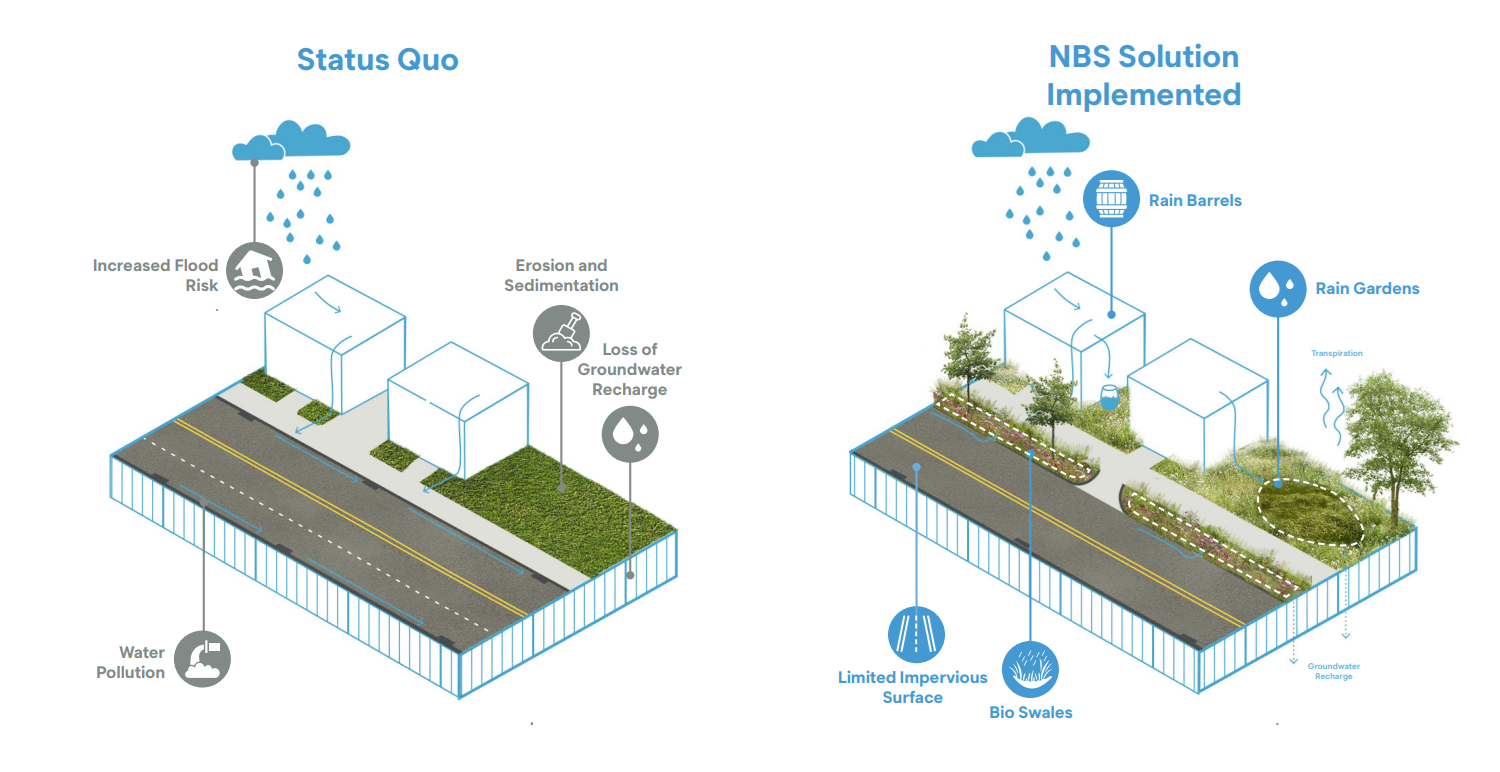
By planting more native plants and reducing the amount of concrete, we can reduce flood risk, improve water quality and recharge groundwater. Image courtesy of Superbloom.Why Nature-Based Solutions Matter

Hard surfaces make Boulder County hot
Hard surfaces like roads and sidewalks contribute to problems that are being made worse by climate change. These hard surfaces don’t let water soak into the ground, which causes problems like:
- Hotter local temperatures
- Flooding
- Dirty water
- Fewer plants and animals

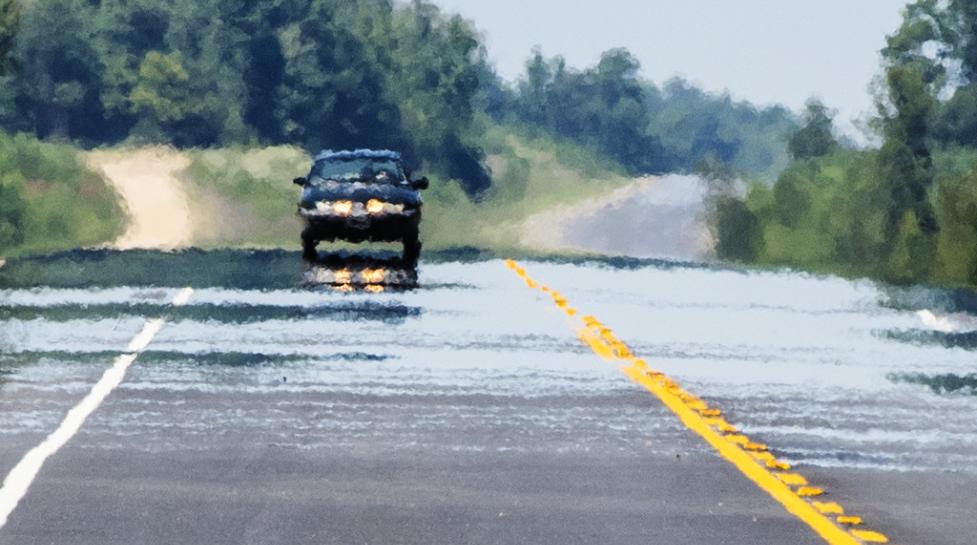
Climate Change makes heat worse
By 2050, Boulder County expects 43 days per year with temperatures exceeding 92.5ºF
Urban and suburban areas are most susceptible to increased warming because sparse vegetation, concrete, and asphalt create urban heat islands.

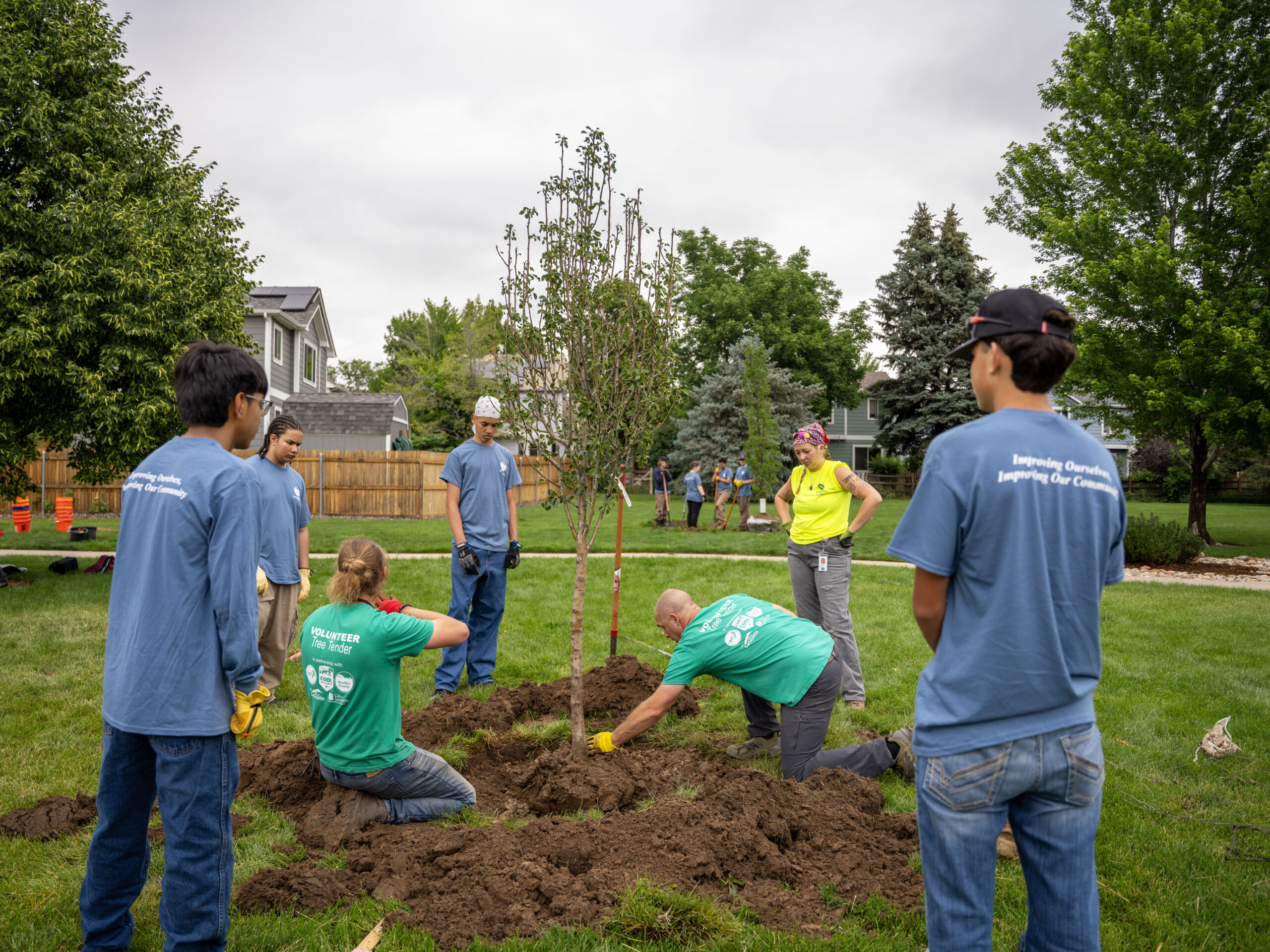
Green spaces make our communities healthier
Adding green spaces like trees, gardens, and green roofs can help make our communities stronger and healthier. These green features help with things like:
- Reducing flooding
- Cleaning the air and water
- Decreasing local air temperatures
- Improving people’s health
2026 Awards
The county selected three projects from nine applications. Projects were evaluated based on the amount of impervious surface they would replace, benefits to disproportionately impacted communities, number of partners involved, and total square footage converted from grey to green.
Project Details
City of Boulder – “Food Forest” – $30,000
This project will turn a neglected two‑acre parcel at 55th and Valmont into a community food forest. The site will be redesigned to mimic natural ecosystems, improving biodiversity, soil health, and water management. Located in an underserved area, the project will also expand access to green space, local food, and community‑led ecological education.
PLAY Boulder Foundation “Non-Functional Turf Conversion to Native Gardens at San Lazaro Mobile Home Community” – $20,000
PLAY Boulder will partner with residents of the San Lazaro Mobile Home Community to remove non‑functional turf from ten front yards and replace it with native trees, shrubs, and pollinator‑friendly gardens. The project will reduce water use, improve soil health, increase biodiversity, and create cooler microclimates. Residents will be hired to assist with installation and early maintenance.
3123 Sterling Circle “Rooftop Agrivoltaic” – $50,000
This project will install a 19,646‑square‑foot agrivoltaic green roof on a new net‑zero commercial building. The roof integrates vegetation with raised solar panels, reducing heat, improving stormwater retention, supporting urban biodiversity, and enhancing solar performance. It will serve as a demonstration site for combining renewable energy with green infrastructure.
Program Goals
- Direct resources to Boulder County municipalities and other entities to implement nature-based solutions from the Urban Landscape Toolkit.
- Reduce impervious surfaces and non-functional turf in Boulder County.
- Expand green spaces to enhance resilience to climate impacts (extreme heat, drought, flooding, biodiversity loss).
- Improve stormwater management, infiltration, carbon sequestration, cleaner air, and urban cooling.
- Advance climate equity by directing resources and benefits to disproportionately impacted communities.
- Create replicable and scalable models of resilient urban landscapes.
Eligibility
- Funding is available to municipalities, businesses, non-profit organizations, schools, and Homeowner Associations (HOAs).
- Applicants must be formally registered entities (e.g., business, non-profit, HOA, educational institution, or government).
- For projects at multifamily units (MFUs) or manufactured home parks, an eligible organization must apply on behalf of the property with the property owner’s permission.
- Business applicants must have been in operation for at least one year.
- Projects located on private single-family residential properties are not eligible.
- Public-private and intergovernmental partnerships are encouraged.
If multiple organizations are collaborating on a project, one must serve as the Lead Applicant.
- The Lead Applicant must be an eligible organization, and will be responsible for submitting the application, serving as the main point of contact, and—if awarded—entering into the funding agreement with Boulder County.
- The project does not need to be located at the Lead Applicant’s property or facility, but the Lead Applicant must have the necessary permissions to carry out the work.
- The Lead Applicant will be legally and financially responsible for all grant requirements, including reporting and invoicing.
- Partner organizations may assist with project design, outreach, or implementation but will not have a direct contract with Boulder County.
- Partners may receive funds only through a subcontract or agreement with the Lead Applicant.
- All partners should be clearly identified in the application, with defined roles and responsibilities.
- All projects must be implemented within the boundaries of Boulder County.
- Applicants must ensure projects must follow all federal, state/local land use regulations and permit requirements. The applicant is responsible for researching and complying with all such rules, regulations, and permits.
Costs directly associated with the design, planning, and implementation of a grey to green project, including but not limited to:
- Site preparation
- Purchase and installation of materials
- Design and engineering services
- Contractor and labor specific to project installation
- Equipment rentals and tools necessary for project implementation
- Permitting fees required for project execution
- Irrigation
- Community engagement (up to 10% of budget)
- Repayment of existing debt, or pre-existing tax liens or obligations
- Payment of organizational overhead exceeding 15% of proposed project budget
- Legal fees
- Loan or bank fees
- Subsidization of existing contracts
- Funds for start-up business
- Labor for existing programs
- Travel
- Maintenance
Application Evaluation and Scoring
Applicants will be scored on the following categories:
- Number of Project Partnerships
- Percent of Impervious Surface
- If Project is located in a Colorado EnviroScreen Census Block
- Benefit to Disproportionately Impacted Communities as defined by CDPHE
- Project Narrative and Ecological Performance
- Size of Grey to Green Conversion
- Project Design Lead Experience and Plant List
- Timeline and Maintenance Plan
- Budget
Scoring Committee members will be comprised of three internal and three external experts in urban landscape NBS. In 2025, this includes the following seats:
- Natural Climate Solutions Specialist, OSCAR, Boulder County
- Climate Equity Specialist, OSCAR, Boulder County
- Senior Sustainability Strategist and Regenerative Agriculture Expert, OSCAR, Boulder County
- Stormwater Specialist, Boulder County
- Landscape Architect, City of Boulder
- Horticulturist and Green Roof Expert, Colorado State University
Fund Administration
The 2026 Grey to Green Fund is administered by Boulder County’s Office of Sustainability, Climate Action, and Resilience (OSCAR).
Funding for this project comes from the Boulder County Sustainability Tax.