Background
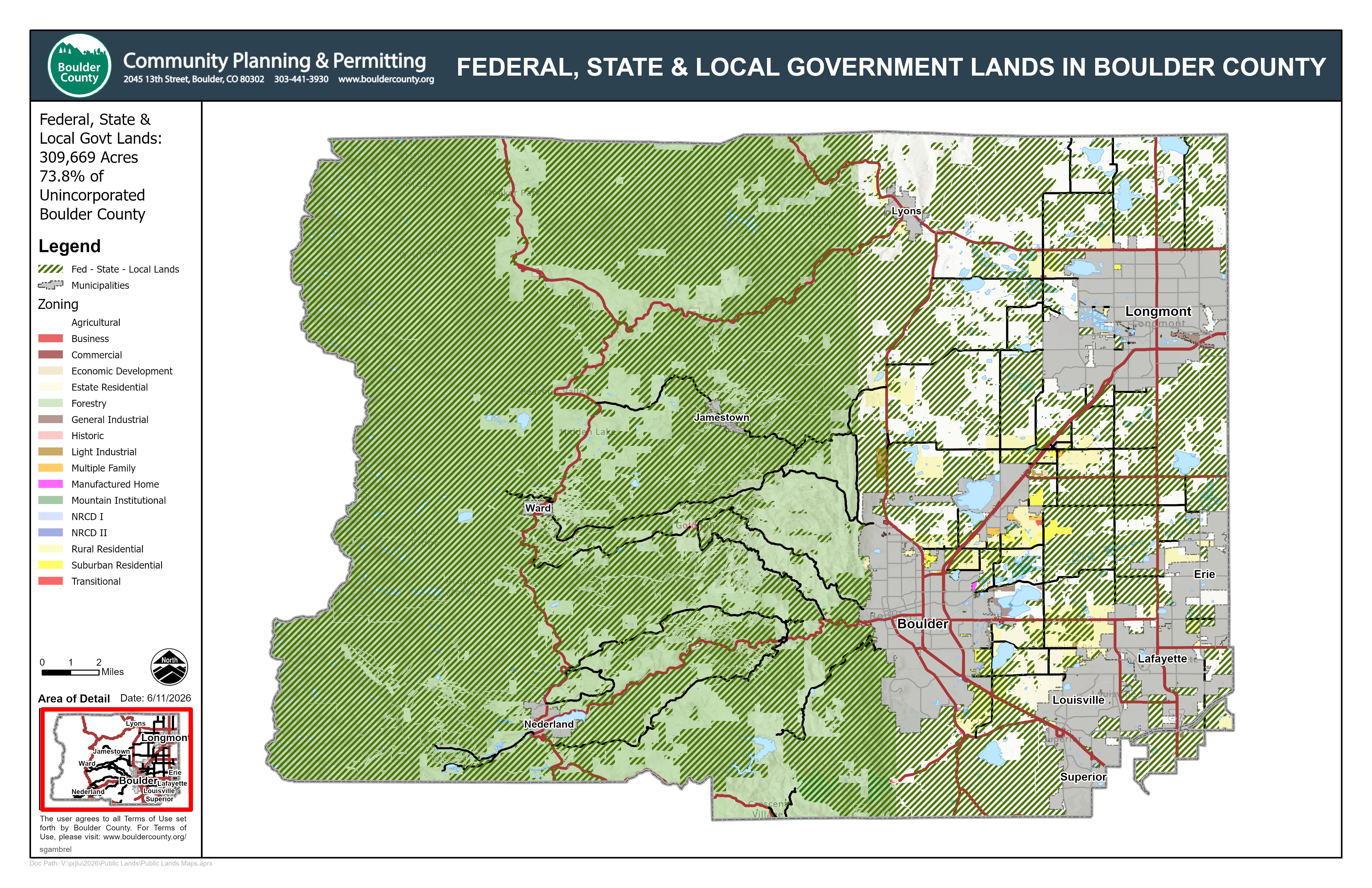
Federal, State and Local government owned lands account for approximately 73.8% of the unincorporated county or 309, 669 acres.
The federal government is the largest public land holder by area. Federal ownership includes Bureau of Land Management lands, Federal research properties including Table Mountain, United States Forest Service Roosevelt National Forest including Indian Peaks and James Peak Wilderness areas, and Rocky Mountain National Park. Federal land holdings are concentrated in the western half of the county within the Forestry zone district and total or 40.3% of unincorporated Boulder County. Although historically, federal ownership and management of these lands has been cohesive and aligned with Boulder County goals for these sensitive, rural, remote and hazardous areas this could change. The Forestry zone district requires a 35-acre minimum lot size, which means federal lands disposed of in portions of at least this size would be considered legal building lots.
State ownership of land with the county is more limited in scope and includes Eldorado Canyon State Park, facilities such as those operated by CDOT on Ridge Road, and State Land Board lands. These lands are also typically located within the Forestry zone district. An initial look into State ownership found that the State owns 0.5% of unincorporated Boulder County.
Boulder County and local municipalities own land in the unincorporated county. These holdings include, county and municipal open space, watershed lands, public facilities such as water and wastewater treatment plants, water storage reservoirs, county buildings and road maintenance facilities.
Special Districts (Title 32 districts) such as fire districts, water and sanitation districts, and school districts also own land within the unincorporated county. Generally, these are purpose driven properties that support the districts’ service delivery mission and are locations for their operations. These districts, with the exception of school districts, typically do not hold vacant lands.
With this Land Use Code text amendment and comprehensive rezoning, a deeper look into the various public holdings, their current uses, and if the current and potential future of these parcels is in alignment with current zoning will be undertaken. The county may explore zoning options to provide a framework for better achieving county goals.
Boulder County may consider concepts that create zoning that (1) preserves resources and prevents undesirable development; and (2) recognizes that some public lands could be classified and regulated differently than they currently are in order to recognize and facilitate their public uses and purposes.