Stage 2 Fire Restrictions Enacted for Western Boulder County; Stage 1 Fire Restrictions Enacted for Eastern Boulder County.

Boulder County government offices closed Friday, July 3. Trailheads close at 7:30 p.m. on July 4 and reopen at sunrise on July 5.

Wildfire smoke is causing poor air quality. Learn more

Ignition Resistant Construction – B37 (effective July 1, 2026)
Building code cover

Boulder County Building Publications
Ignition Resistant Construction - B37 (effective July 1, 2026)

Boulder County’s Building Publication B-37 outlines ignition-resistant construction requirements for new projects and remodels in Wildfire Zones 1,2, and 3, detailed in Section R390 of the 2021 Boulder County Building Code Amendments. For building permits applied for under previous codes, property owners should consult one of the following links:

R390.1 Requirements based on locations in wildfire zones

R390.1.1 General

Unless other more restrictive requirements, such as those requiring an approved wildfire mitigation plan imposed through Site Plan Review or other review processes required by the Boulder County Land Use Code, apply, this section shall be applicable to all new buildings, additions, alterations, and repairs, including buildings designed and constructed in accordance with the International Building Code® and International Wildland-Urban Interface Code®.

Exceptions:

    1. One-time additions not exceeding 200 square feet in floor area.
    2. Accessory structures not exceeding 120 square feet (11 square meters) in floor area located not less than 50 feet (15 240 mm) from buildings containing habitable spaces.
    3. Agricultural buildings not exceeding 200 square feet (18.58 square meters) not less than 50 feet (15 240 mm) from buildings containing habitable spaces.
    4. Historic Buildings where the requirements of this section directly interfere with contributing elements of the historic designation.
    5. One time exception, when the reconstruction, replacement, alteration, or repair of the exterior walls of an existing building, when less than 25 percent of the surface area of all exterior walls is affected, compliance to R390.4.6 is not required.
    6. One time exception, when the reconstruction, replacement, alteration, or repair of the exterior roof covering of an existing building, when less than 25 percent of the surface area of the exterior roof covering or an attachment thereto is affected, compliance to R390.4.1 is not required.

R390.1.2 Retroactivity

The provisions of the code shall apply to conditions arising after the adoption thereof, conditions not legally in existence at the adoption of this code and conditions that, in the opinion of the code official, constitute a distinct hazard to life or property.

Exception:

Provisions of this code that specifically apply to existing conditions are retroactive.

Note:

Refer to sections referencing existing buildings and existing structures, including but not limited to the Boulder County Building Code Amendments sections 101.4.8, 102.6, IRC Appendix AJ, and International Existing Building Code.

R390.2 Wildfire Zones Defined

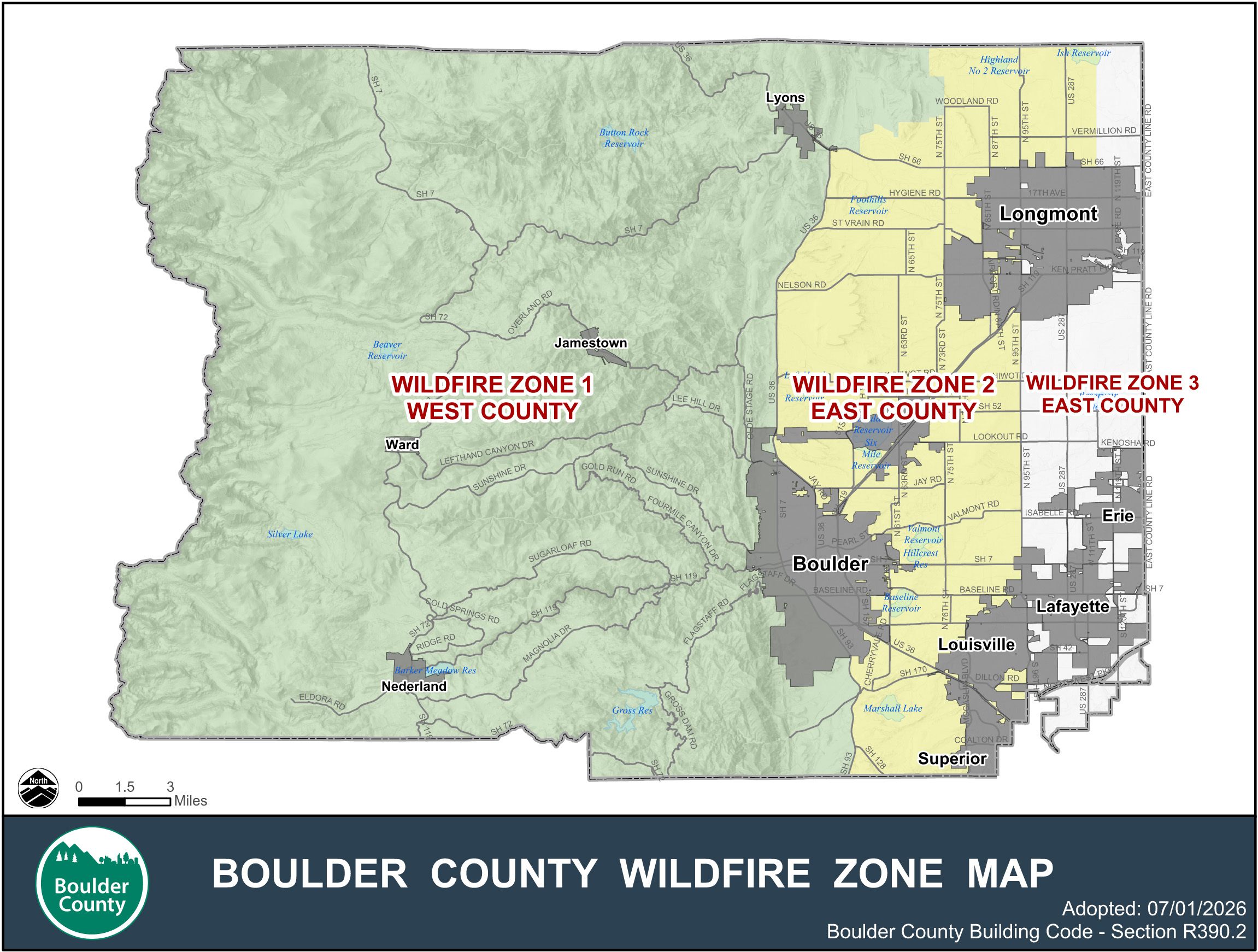
For the purpose of this code, the unincorporated portion of Boulder County is divided into wildfire zones, which shall be known and designated as Wildfire Zone 1-West County, Wildfire Zone 2-East County, and Wildfire Zone 3-East County. The wildfire zones shall include such territory or portions of the unincorporated county as shown in Figure R390.2, the Wildfire Zone Map.

R390.2.1 Buildings Located in More Than One Wildfire Zone

A building or structure that is located partly in one wildfire zone and partly in another shall be considered to be in the wildfire zone in which the more restrictive conditions apply.

R390.2.2 Moved Buildings

Any building or structure moved within or into any wildfire zone shall be made to comply with all the requirements for new buildings in that wildfire zone.

Map of three wildfire zones. Wildfire Zone 1 is from western county line boundary at the continental divide to the east boundary generally along the west side of Foothills Highway. Wildfire Zone 2 is from east of Foothills Highway toward a north-south boundary of 115th Street from the north county line to the north side of Longmont then proceeding south from 95th street to the south county line boundary. Wildfire Zone 3 is from It is east of north-south boundary of 115th Street from the north county line to the north side of Longmont then proceeding south from 95th street to the south county line boundary and toward the east county line.

Figure R390.2: Wildfire Zone Map

R390.3 Definitions

The following words and terms shall, for the purpose of this Section, have the meanings shown herein.

Defensible Space

An area either natural or manmade, where material capable of allowing a fire to spread unchecked has been treated, cleared or modified to slow the rate and intensity of an advancing wildfire and to create an area for fire suppression operations to occur.

Defensible Space Management Zone

A defensible space, or fuel modification area referenced in proximity to a structure, building, or a property line. Also referenced in R390.4.12, and subsections.

Defensible Space Management Zone 1

A zone that extends at 5-feet to 30 feet from the structure including structure projections.

Defensible Space Management Zone 2

A zone that extends more than 30 feet to 100 feet from the structure including structure projections.

Defensible Space Standard

The Colorado State Forest Service publication, Protecting Your Home from Wildfire: Creating Wildfire-Defensible Zones, 2012 Quick Guide is an approved standard for meeting the defensible space requirements of Section R390.4.12 or for the creation of a wildfire mitigation plan.

Fire Retardant Treated Wood

Wood products that, when impregnated with chemicals by a pressure process or other means during manufacture, exhibit reduced surface-burning characteristics and resist propagation of fire, as defined in IBC 202 and IRC R202. Wood meeting the requirements of section R802.1.5 of the International Residential Code® or section 2303.2 of the International Building Code®.

Fuel Modification

A method of modifying fuel load by reducing the amount of nonfire-resistive vegetation or altering the type of vegetation to reduce the fuel load.

Heavy Timber Construction (Type IV, HT)

Construction with wood framing members, columns, flooring and roof decks sized in accordance with International Building Code® Section 602.4.

Ignition-Resistant Building Material

Ignition-resistant building materials shall comply with any one of the following:

    1. Material shall be tested on the front and back faces in accordance with the extended ASTM E84 or UL 723 test, for a total test period of 30 minutes, or with the ASTM E2768 test. The materials shall bear identification showing the fire test results. Panel products shall be tested with a ripped or cut longitudinal gap of 1/8-inch. The materials, when tested in accordance with the test procedures set forth in ASTM E84 or UL 723 for a test period of 30 minutes, or with ASTM E2768, shall comply with the following subsections 1.1 through 1.3, and subsections therein. Materials or products which melt, drip or delaminate to the extent that the flame front is interrupted are not permitted.

      Exception:

      Materials composed of a combustible core and a noncombustible exterior covering made from either aluminum at a minimum 0.019-inch thickness or corrosion-resistant steel at a minimum 0.0149-inch thickness shall not be required to be tested with a ripped or cut longitudinal gap.

      1.1 Flame spread. Material shall exhibit a flame spread index not exceeding 25.

      1.2 Flame front. Material shall exhibit a flame front that does not progress more than 10-feet and 6-inches (3200 mm) beyond the centerline of the burner at any time during the test.

      1.3 Weathering. Ignition-resistant building materials shall maintain their performance in accordance with this Section under conditions of use. Materials shall meet the performance requirements for weathering (including exposure to temperature, moisture and ultraviolet radiation) contained in the following sections 1.3.1 through 1.3.3 and subsections therein, as applicable to the materials and the conditions of use.

      1.3.1 Evaluation requirements for weathering. Fire-retardant-treated wood, wood-plastic composite materials and plastic lumber materials shall be evaluated after weathering in accordance with Method A “Test Method for Accelerated Weathering of Fire-Retardant-Treated Wood for Fire Testing” in ASTM D2898.

      1.3.2 Wood-plastic composite materials. Wood-plastic composite materials shall also demonstrate acceptable fire performance after weathering by the following procedure: first testing in accordance with ASTM E1354 at an incident heat flux of 50 kW/ m2 in the horizontal orientation, then weathering in accordance with ASTM D7032 and then retesting in accordance with ASTM E1354 and exhibiting an increase of no more than 10 percent in peak rate of heat release when compared to the peak heat release rate of the nonweathered material.

      1.3.3 Plastic lumber materials. Plastic lumber materials shall also demonstrate acceptable fire performance after weathering by the following procedure: first testing in accordance with ASTM E1354 at an incident heat flux of 50 kW/ m2 in the horizontal orientation, then weathering in accordance with ASTM D6662 and then retesting in accordance with ASTM E1354 and exhibiting an increase of no more than 10 percent in peak rate of heat release when compared to the peak heat release rate of the nonweathered material.

      1.4 Identification. All materials shall bear identification showing the fire test results.

    2. Noncombustible material. Material that complies with the requirements for noncombustible materials in this section, including but not limited to approved materials as follows:

      2.1 Cementitious stucco

      2.2 Cementitious cladding

      2.3 Metal sheeting comprised of either aluminum at a minimum 0.019-inch (0.48 mm) thickness or corrosion- resistant steel at a minimum 0.0149-inch (0.38 mm) thickness.

    3. Fire-retardant-treated wood. Fire-retardant-treated wood labeled for exterior use. Where a section also specifies fire-retardant-treated wood with a dimensional thickness, the specified dimension at a minimum is required.

Log Wall Construction

A type of construction in which exterior walls are constructed of solid wood members and where the smallest horizontal dimension of each solid wood member is at least 6-inches (152 mm).

Multilayered Glazed Panels

Window or door assemblies that consist of two or more independently glazed panels installed parallel to each other, having a sealed air gap in between, within a frame designed to fill completely the window or door opening in which the assembly is intended to be installed.

Noncombustible

As applied to building construction material means a material that, in the form in which it is used, is either one of the following:

    1. Material of which no part will ignite and burn when subjected to fire. Any material conforming to ASTM E 136 shall be considered noncombustible within the meaning of this Section.
    2. Material having a structural base of noncombustible material as defined in Item 1 above, with a surfacing material not over 1/8 inch (3.2 mm) thick, which has a flame spread index of 50 or less. Flame spread index as used herein refers to a flame spread index obtained according to tests conducted as specified in ASTM E 84 or UL723.
    3. For the purposes of this code, fire-rated gypsum board tested in accordance with ASTM C1396 with no less than a 1-hour fire-resistance-rating with fire exposure from the outside only is considered a noncombustible material.

“Noncombustible” does not apply to surface finish materials. Material required to be noncombustible for reduced clearances to flues, heating appliances or other sources of high temperature shall refer to material conforming to Item 1. No material shall be classified as noncombustible that is subject to increase in combustibility or flame spread index, beyond the limits herein established, through the effects of age, moisture or other atmospheric condition.

Wildfire Mitigation Plan

A wildfire mitigation plan addresses the risk of wildfire both to the subject property and those posed to neighboring properties in the surrounding area by the proposed development through appropriate site location for structures, construction design and the use of ignition-resistant building material, defensible space and fuel reduction around structures, driveway access for emergency vehicles and an emergency water supply for firefighting in accordance with Article 4-804(C.)(12.) and Article 4-806(A.)(5.) of the Boulder County Land Use Code.

Wildfire Partners

Wildfire Partners is a collaborative Boulder County wildfire hazard mitigation program for homeowners that helps to reduce the risk of damage to homes from wildland fire. In Wildfire Partners, homeowners take personal responsibility for preparing their home and property for wildland fire and actively participate in an onsite assessment with a wildfire mitigation specialist. When participants complete their customized wildfire mitigation plan and pass their follow up inspection, they receive a Wildfire Partners Certificate and may be eligible for financial assistance.

R390.4 Restrictions in Wildfire Zones

Individual buildings or structures constructed in Wildfire Zone 1-West County, Wildfire Zone 2-East County, and Wildfire Zone 3-East County shall comply with this section.

R390.4.1 Roof covering

Roofs shall have a roof assembly that complies with a Class A rating when tested in accordance with ASTM E108 or UL 790.

Exceptions:

    1. Class A roof assemblies include those with coverings of brick, masonry or an exposed concrete roof deck.
    2. Class A roof assemblies also include ferrous or copper shingles or sheets, metal sheets and shingles, clay or concrete roof tile or slate installed on noncombustible decks or ferrous, copper or metal sheets installed without a roof deck on noncombustible framing.
    3. Class A roof assemblies include minimum 16 ounce per square foot (0.0416 kg/m2) copper sheets installed over combustible decks.
    4. Class A roof assemblies include slate installed over ASTM D226, Type II underlayment over combustible decks.

R390.4.1.1 Flame and ember protection of roofs

For roof assemblies where the roof covering profile creates a space between the roof covering and roof deck, the space shall resist the entry of flames and embers by one or more of the following methods:

  1. Firestopping with noncombustible material of the space between the roof covering and the roof deck.
  2. Installation of one layer of cap sheet complying with ASTM D3909 over the combustible roof deck.
  3. Installation of a listed Class A classified roof assembly.

R390.4.1.2 Roof Valleys

When provided, valley flashings shall be not less than 0.019-inch (No. 26 galvanized sheet gauge) corrosion-resistant metal installed over a minimum 36-inch (914 mm) wide underlayment consisting of one layer of 72-pound mineral- surfaced, non-perforated cap sheet complying with ASTM D 3909 running the full length of the valley.

R390.4.1.3 Light transmitting plastics in roof installations

In all Wildfire Zones, light-transmitting plastics, including thermoplastic, thermosetting or reinforced thermosetting plastic material, shall conform to the Class CC1 combustibility classification referenced in the International Building Code section 2606.4.

R390.4.1.4 Existing roof structures

The roof covering on buildings or structures in existence prior to adoption of this code that are replaced or have 25 percent or more of the surface area of the roof replaced, or where work to reconstruct, alter, or repair the roof covering effectively replaces such material, shall require the entirety of the roof covering to be replaced with a roof covering required for new construction specified in Sections R390.4.1 through R390.4.1.3.

Exception:

Existing roof coverings that are compliant with Section R390.4.1 through R390.4.1.3.

R390.4.2 Gutters and downspouts

Gutters, downspouts, and gutter covering devices shall be constructed of noncombustible material. Gutters shall be provided with an approved means to prevent the accumulation of leaves, pine needles and debris in the gutter. Where downspouts, gutters and/or gutter guards are replaced or installed they shall be of noncombustible material.

Exceptions:

    1. Buildings meeting one of the exceptions to International Residential Code section R401.3.1 and International Building Code section 1804.4 of this code may be constructed without gutters and downspouts.
    2. Structures where gutter guards have not been previously installed and a reroof is performed, do not require gutter guards to be installed.

R390.4.3 Spark arrestors

Chimneys serving fireplaces, barbecues, incinerators or decorative heating appliances in which solid or liquid fuel is used shall be protected with a spark arrester. Spark arresters shall be constructed of woven or welded wire screening of 12 USA standard gauge wire (0.1046 inch)(2.66 mm) having openings not exceeding 1/2-inch (12.7 mm). The net free area of the spark arrester shall not be less than four times the net free area of the outlet of the chimney.

R390.4.4 Fences, retaining walls and similar appurtenances

Fences, retaining walls or other appurtenances that connect to buildings must be constructed of noncombustible materials or ignition-resistant materials for a distance of 5-feet from the exterior walls as referenced in R390.4.4.1 through R390.4.4.2, or as specified in the subsection.

R390.4.4.1 Fencing

Fencing within 5 feet of a structure regulated by this code or up to the property line when the property line is less than 5 feet away from the structure shall be constructed with noncombustible materials.

R390.4.4.2 Retaining walls

Retaining walls shall be constructed with either noncombustible or ignition-resistant materials when any of the following conditions exist:

  1. The retaining wall is within 8 feet of a structure regulated by this code or up to the property line when the property line is less than 8-feet away from the structure.
  2. The retaining wall is integral to the support of a structure regulated by this code.
  3. The retaining wall is integral to the egress from a structure regulated by this code to a public way, easement, or private road.

R390.4.5 Overhanging projections

All exterior projections including, but not limited to, exterior balconies, carports, decks, patio covers, porch ceilings, unenclosed roofs and floors, overhanging buildings and similar architectural appendages and projections shall be protected as specified in this section.

R390.4.5.1 Exterior open covers, patio covers, porch ceilings, roof eaves, soffits and cornices.

The exposed underside of exterior patio ceilings, porch ceilings, rafter or truss eaves, soffits, and cornices shall be protected by one of the following:

  1. Noncombustible material.
  2. Ignition-resistant material.
  3. Heavy timber construction.
  4. 3/4-inch-thick nominal fire retardant-treated plywood labeled for exterior use.
  5. Any approved inherently noncombustible material as defined by the NFPA, with approved defensible space within 12-feet (3658 mm) above grade.

Exception:

Rafter tails or roof beam ends may be exposed if they are heavy timber having minimum dimensions not less than 6-inch (152 mm) nominal in width and not less than 8-inches (203 mm) nominal in depth.

R390.4.5.1.1 Protection of fascia

The leading edge of the roof at the fascia must be finished with a metal drip edge so that no wood sheathing is exposed.

R390.4.5.1.2 Soffits and eaves extending over horizontal surfaces

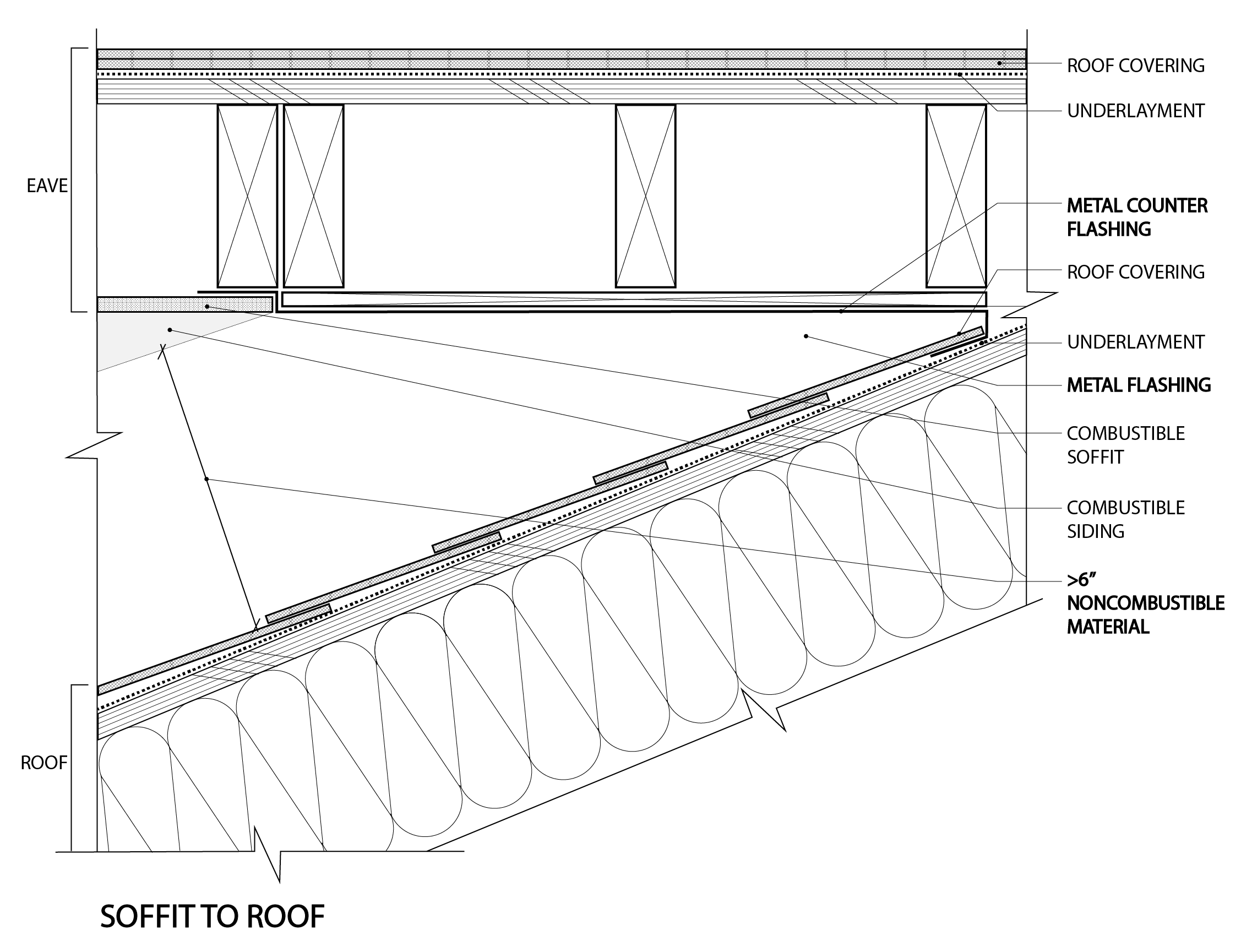
Metal flashing or noncombustible material shall be installed on the exterior of the wall and eaves within a minimum of 6-inches (152 mm) of roof intersections.
An illustration showing the construction detail for the protection of combustible material within at least 6 inches of a roof surface, including the soffit. 

R390.4.5.2 Floor projections, and similar projections, 12 feet or less above finished grade.

Buildings or structures shall have all underfloor areas enclosed to the ground with exterior walls in accordance with Section R390.4.6. For decks, see Section R390.4.8.

Exception:

Exterior floor projections and similar projections measured from finished grade or nearest horizontal surface to the underside of the framing member to any point along that projection shall be protected. Where the projection is 12 feet or less above finished grade or the nearest horizontal surface below, it shall be protected in accordance with one of the following:

  1. Heavy timber construction.
  2. 3/4-inch (19.0 mm) thick nominal fire retardant-treated plywood labeled for exterior use.
  3. One layer of 5/8-inch (15.9 mm) Type X exterior gypsum sheathing applied behind an exterior covering on the underside of the floor projection. Where finish materials are applied to the surface, those materials must be ignition resistant
  4. The exterior portion of a 1-hour fire-resistance-rated exterior assembly, as tested in accordance with ASTM E119 or UL 263, applied to the underside of the ceiling, roof ceiling or floor/ceiling, assembly, including assemblies using the gypsum panel and sheathing products listed in the Gypsum Association Fire Resistance Design Manual. Where finish materials are applied to the surface, those materials must be ignition resistant.
  5. Materials approved for not less than 1-hour fire resistance-rated construction on the exterior side, as tested in accordance with ASTM E119 or UL 263. Where finish materials are applied to the surface, those materials must be ignition resistant.
  6. Floor projections and similar projections cumulative of 200 square feet (18.58 m2) or less shall comply with R390.4.5.3.

R390.4.5.3 Floor projections, and similar projections, greater than 12 feet above finished grade.

Buildings or structures shall have all underfloor areas enclosed to the ground with exterior walls in accordance with Section R390.4.6. For decks, see Section R390.4.8.

Exception:

Exterior floor projections and similar projections measured from finished grade or nearest horizontal surface to the underside of the framing member to any point along that projection shall be protected. Where the projection is greater than 12 feet above finished grade or the nearest horizontal surface below it shall be protected in accordance with one of the following:

  1. Any method listed in R390.4.5.2.
  2. Noncombustible material.
  3. Ignition-resistant material.
  4. Heavy timber construction.
  5. 3/4-inch-thick nominal fire retardant-treated plywood labeled for exterior use.
  6. Any inherently noncombustible material as defined by the NFPA.

R390.4.6 Exterior walls

Exterior walls of buildings or structures shall be constructed with one of the following methods:

    1. Approved noncombustible materials.
    2. Heavy timber construction or log wall construction.
    3. Fire-retardant-treated wood labeled for exterior use on the exterior side.
    4. Ignition-resistant materials on the exterior side.

Such material shall extend from the top of the foundation to the underside of the roof sheathing.

Exception:

Trim is not required to meet the materials requirements for exterior walls, where installed more than 6-inches (152 mm) above grade, floor, deck, or roof where wall abuts the horizontal surface.

R390.4.6.1 The base of exterior walls

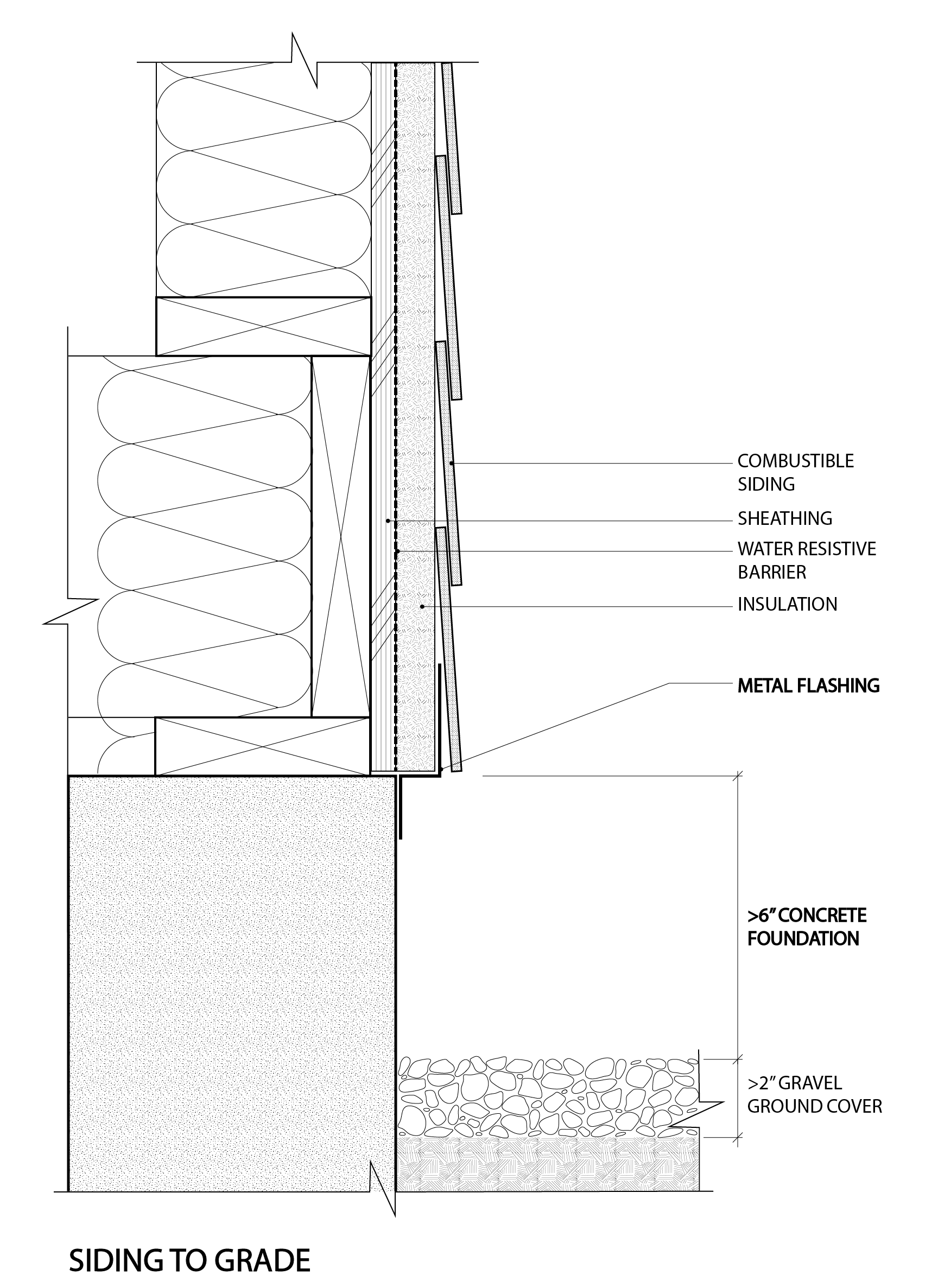
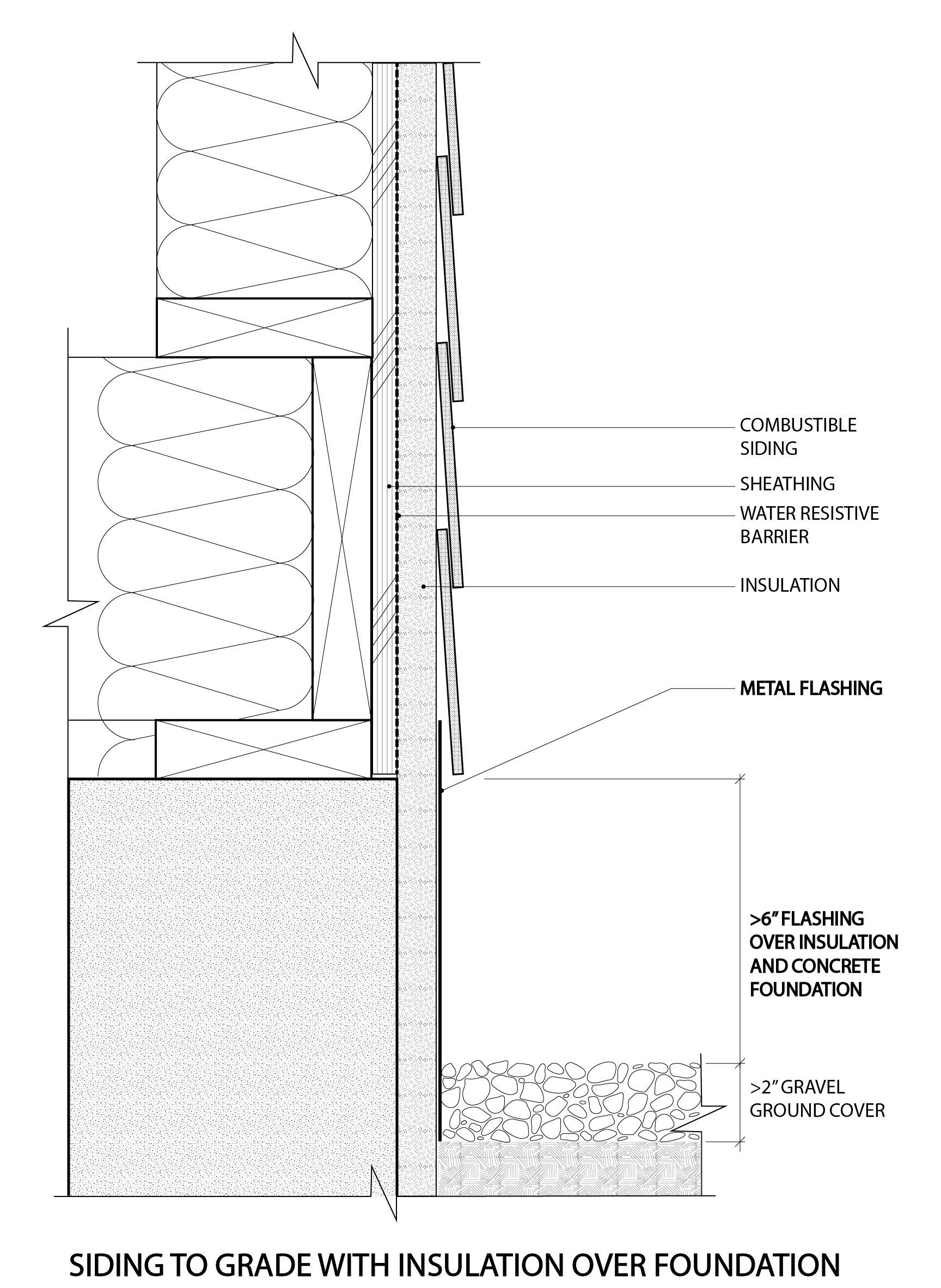
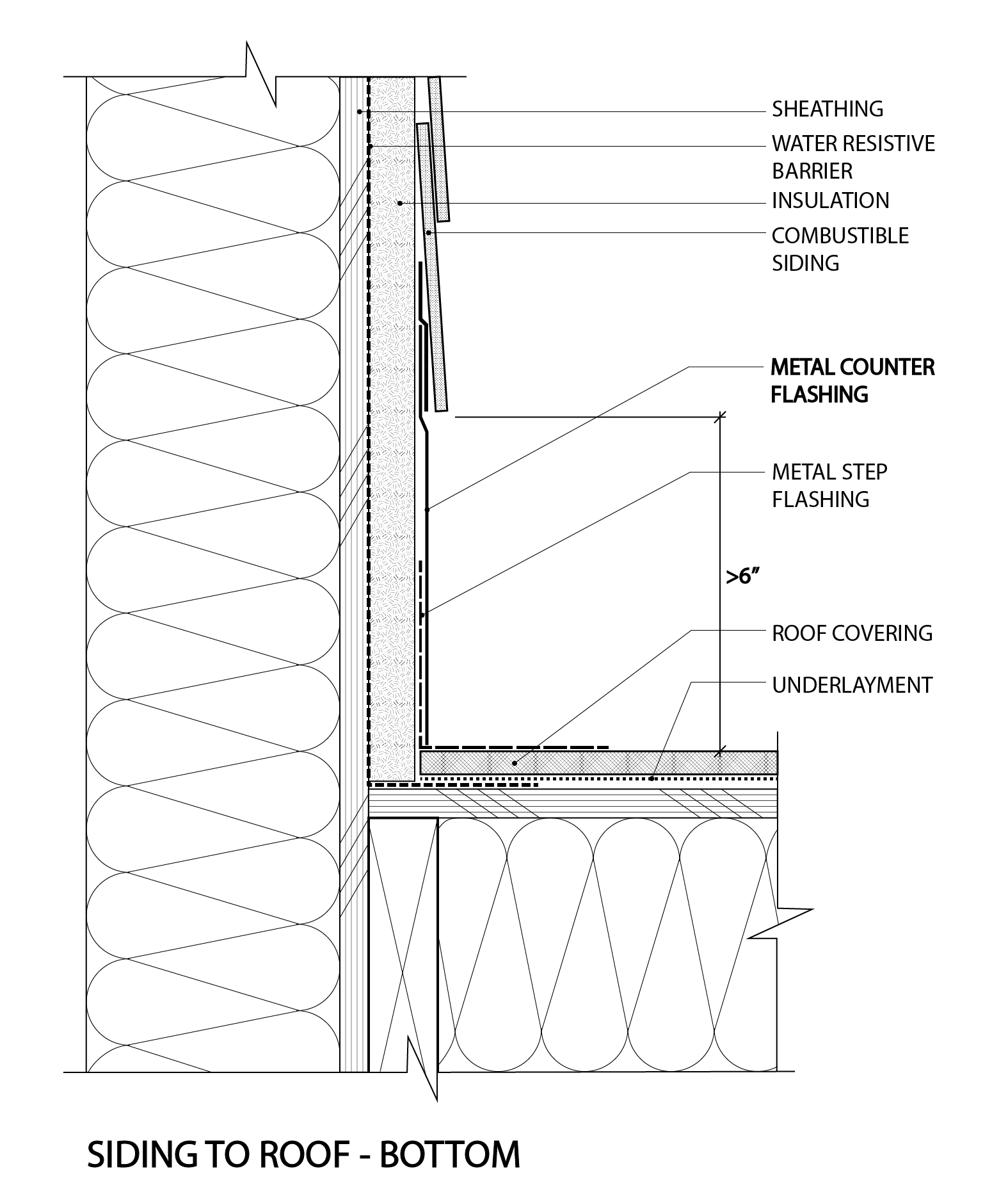
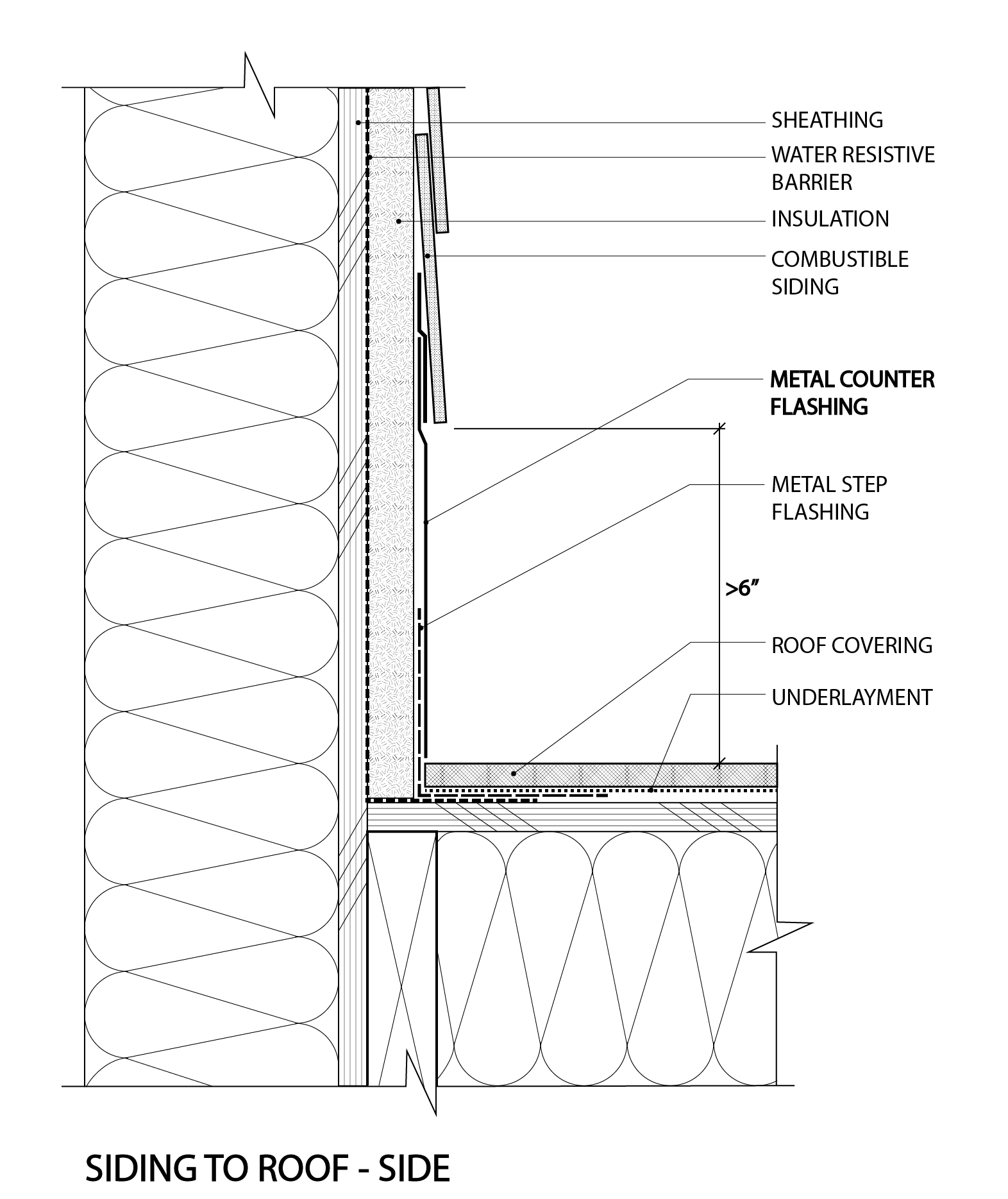
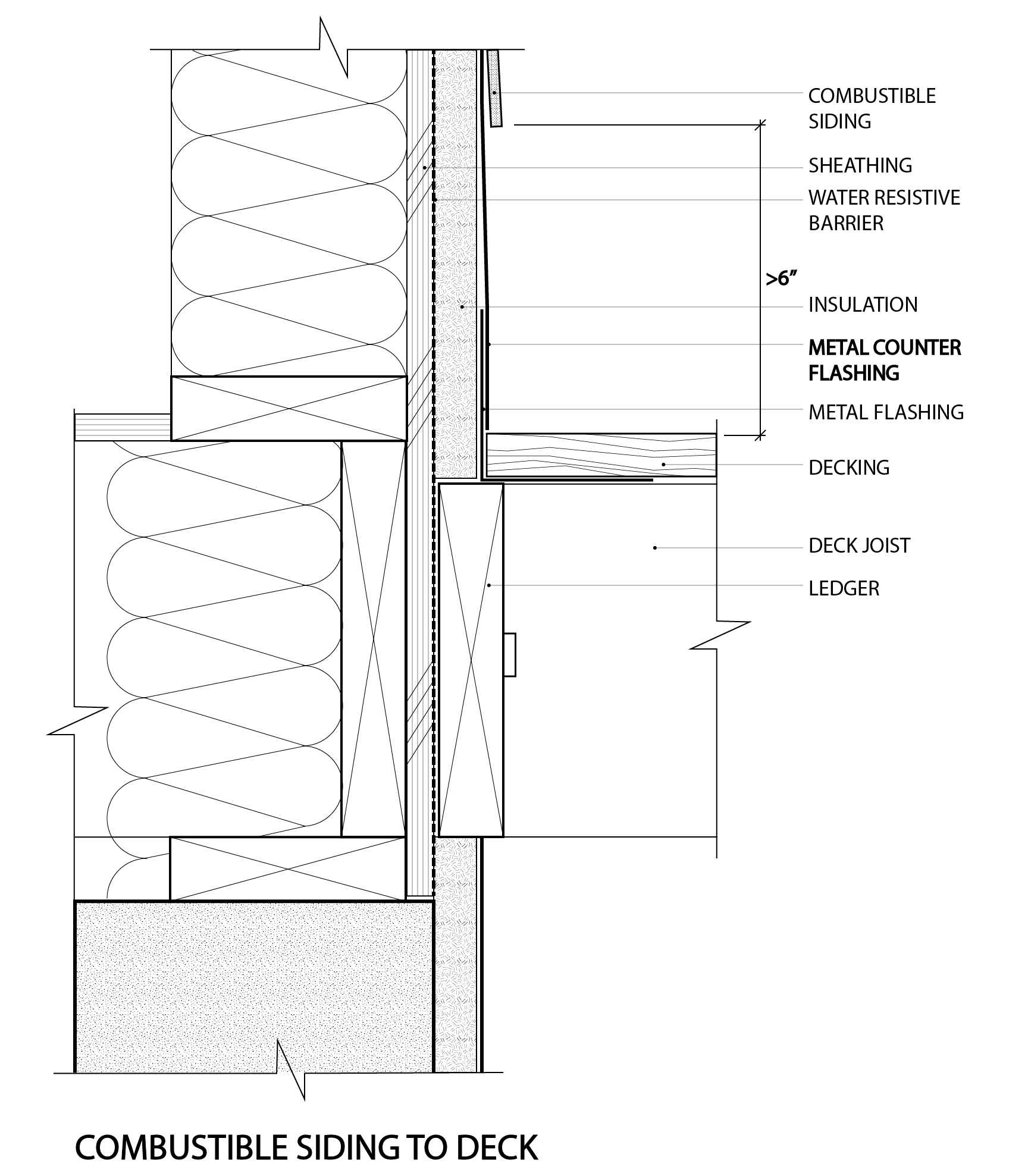
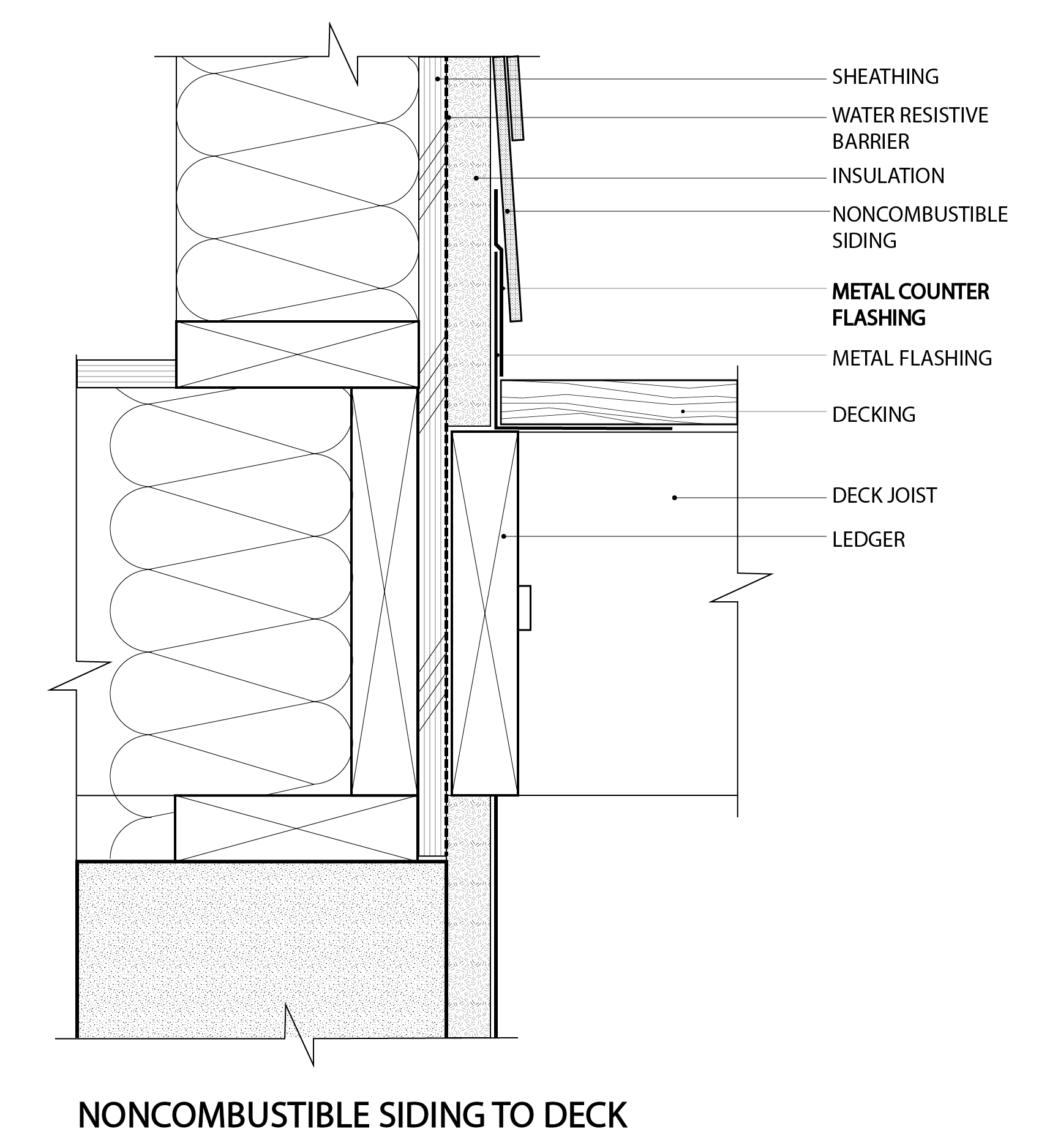
The base of exterior walls within at least 6 inches (152 mm) of the ground, decking, and roof intersections must be protected by all of the following.

  1. Metal flashing or noncombustible material shall be applied vertically and installed on the exterior side of the wall.
  2. Combustible sheathing products exposed by the gap created at the base of the exterior walls, posts, or columns must be protected with noncombustible material, such as a metal weep screed, while still permitting drainage and moisture control from behind exterior cladding.

An illustration showing the construction detail for the protection of combustible materials within at least 6 inches of the ground. 

An illustration showing the construction detail for the protection of combustible materials, including foam insulation, within at least 6 inches of the ground. 

An illustration showing the construction detail for the protection of combustible materials, including foam insulation, within at least 6 inches of the roof at the bottom of a dormer or other complex roof feature. 

An illustration showing the construction detail for the protection of combustible materials, including foam insulation, within at least 6 inches of the roof at the side of a dormer or other complex roof feature. 

An illustration showing the construction detail for the protection of combustible materials, including foam insulation, within at least 6 inches of a deck surface.

An illustration showing the construction detail for the protection of foam insulation at the deck to siding junction. 

R390.4.6.2 Existing exterior walls.

The exterior walls of building or structures in existence prior to adoption of this code where 25 percent or more of the total exterior wall surface area is replaced, or where work to reconstruct, alter or repair the exterior walls effectively replaces the exterior wall material, shall require the entirety of the exterior wall surface area, including attachments, to be replaced with materials required for new construction specified in Section R390.4.6 and subsections, and the immediate zone within 5 feet of the structure shall be made to comply with Section R390.4.12.1, weed barrier and gravel or crushed rock requirements.

Exception:

Existing exterior walls that are compliant with Section R390.4.6.

R390.4.7 Reserved

Reserved for future use.

R390.4.8 Decks, appendages, and projections

Decks and other unenclosed accessory structures attached to buildings shall be constructed of the following materials:

R390.4.8.1 Deck surface:

Approved noncombustible material, approved wood thermoplastic composite lumber (ASTM D7032) with an ASTM E84 flame spread index no greater than 75 or class B rated, ignition-resistant building materials, or any approved Class A roof assembly.

R390.4.8.2 Deck framing:

Deck framing shall be constructed of one of the following:

  1. Metal
  2. Heavy timber construction.
  3. Approved noncombustible materials.
  4. Fire-retardant-treated wood labeled for exterior use.
  5. Ignition-resistant building materials.
  6. Wood with a minimum nominal thickness of at least 2-inches for joists and 2-2x members for beams and columns or posts, fastened tightly together.

R390.4.8.3 Deck Rails:

Horizontal deck rails and guard rails shall be constructed of materials allowed under R390.4.8.1 and R390.4.8.2 where within 5-feet of the exterior walls.

R390.4.8.4 Decks less than 4 feet above finished grade

Decks that are less than 4 feet from finished grade to the deck walking surface above, shall be enclosed with noncombustible corrosion-resistant mesh with openings not to exceed 1/8 inches, or other approved materials. Enclosure shall not restrict clearance required for emergency escape and rescue openings required in IRC section R310 and IBC section 1031. The area beneath the deck shall be cleared of vegetation, debris, building materials, and combustible storage.

R390.4.8.5 Pergolas and similar construction

Pergola framing shall be constructed of one of the following:

  1. Metal
  2. Heavy timber construction.
  3. Approved noncombustible materials.
  4. Fire-retardant-treated wood labeled for exterior use.
  5. Ignition-resistant building materials.
  6. Wood with a minimum nominal thickness of at least 2-inches for joists and 2-2x members for beams and columns or posts, fastened tightly together.

R390.4.9 Exterior windows and glazing

Exterior windows, window walls, glazed doors, windows within exterior doors, and skylights shall be tempered glass, multilayered glazing, glass block, or have a fire protection rating of not less than 20 minutes. Unless they are part of a fire-rated assembly, window frames and sashes may be of any material permitted by this code. Windows with unreinforced vinyl frames or sashes are not permitted.

Exception:
Unreinforced vinyl frames are allowed in Wildfire Zone 2-East County and Wildfire Zone 3-East County.

R390.4.10 Exterior doors

Exterior doors and garage doors shall be approved noncombustible construction, metal clad, solid core wood not less than 1-3/4 inches in thickness, or have a fire protection rating of not less than 20 minutes. Windows within doors and glazed doors shall be in accordance with Section R390.4.9.

Exception:
Vehicle access doors

R390.4.10.1 Vehicle Access Door Perimeter Gap.

Exterior vehicle access doors shall resist the intrusion of embers from entering by preventing gaps between doors and door openings, at the head, sill, and jamb of doors from exceeding ⅛ inch as approved by the AHJ. Gaps between doors and door openings shall be controlled by one of the following methods:

  1. Weather-stripping products made of materials that: (a) have been tested for tensile strength in accordance with ASTM D638 (Standard Test Method for Tensile Properties of Plastics) after exposure to ASTM G155 (Standard Practice for Operating Xenon Arc Light Apparatus for Exposure of Non-Metallic Materials) for a period of 2,000 hours, when the maximum allowable difference in tensile strength values between exposed and non-exposed samples does not exceed 10 percent; and (b) exhibit a V-2 or better flammability rating when tested to UL 94 (Standards for Tests for Flammability of Plastic Materials for Parts in Devices and Appliances).
  2. Door overlaps onto jambs and headers.
  3. Garage door jambs and headers covered with metal flashing.

R390.4.11 Vents

Where provided, ventilation openings for enclosed attics, gable ends, ridge ends, under eaves and cornices, enclosed eave soffit spaces, enclosed rafter spaces formed where ceilings are applied directly to the underside of ceilings are applied directly to the underside of roof rafters, underfloor ventilation, foundations and crawl spaces, or any other opening intended to permit ventilation, either in horizontal or vertical surface, including but not limited to rain screens, shall be in accordance with Section R390.4.11.1 or section R390.4.11.2 to resist building ignition from the intrusion of burning embers and flame through the ventilation openings.

R390.4.11.1 Performance requirements

Ventilation openings shall be fully covered with listed vents tested in accordance with ASTM E2886, to demonstrate compliance with all of the following requirements.

  1. There shall be no flaming ignition of cotton material during the Ember Intrusion Test.
  2. There shall be no flaming or ignition during Integrity Test portion of the Flame Intrusion Test.
  3. The maximum temperature of the unexposed side of the vent shall not exceed 662 degrees Fahrenheit (350°C).

R390.4.11.2 Prescriptive requirements

Where provided, attic ventilation openings, foundation or underfloor vents, or other ventilation openings vertical or horizontal surfaces and vents through roofs shall not exceed 144 square inches each. Such vents shall be covered with noncombustible corrosion resistant mesh with openings not to exceed 1/8-inch (3.2 mm) or shall be designed and approved to prevent flame or ember penetration into the structure.


R390.4.12 Defensible space

Individual buildings or structures on a property must be provided with a fuel modification zone in accordance with the defensible space standard. When additions requiring a permit occur, both existing and new structures must be provided with defensible space in accordance with this section. The defensible space management zone or fuel modification zone must be maintained at all times.

Exceptions:

    1. The implementation and completion of an approved wildfire mitigation plan prior to final inspection approval for the project.
    2. Participation in the Wildfire Partners program and the issuance of a Wildfire Partners certificate prior to final inspection approval for the project.
    3. Individual buildings or structures on a property located in Wildfire Zone 2-East County are not required to comply completely with defensible space standard, but must comply with R390.4.12.1 and R390.4.12.2.
    4. Decks on a property located in Wildfire Zone 2-East County and Wildfire Zone 3-East County are not required to comply with defensible space standard. Furthermore, a weed barrier and gravel must be installed on all sides of the deck construction in accordance with Section R390.4.12.1.
    5. Individual buildings or structures on a property located in Wildfire Zone 3-East County are not required to comply with defensible space standard, but must comply with R390.4.12.1.
    6. In Wildfire Zone 1-West County, construction limited to new covered projections, porches, decks, or repairs to existing decks shall adhere solely to the requirements of Defensible Space Management Zone 1 per the defensible space standard. Furthermore, a weed barrier and gravel must be installed on all sides of the construction in accordance with Section R390.4.12.1.

R390.4.12.1 Weed barrier and gravel or crushed rock specific

Note:

 A noncombustible perimeter is required.

A weed barrier and gravel or crushed rock not less than 3/4-inch in diameter applied at least 2-inches thick must be installed beneath decks, unenclosed floors, and around the perimeter of the building to extend at least 5-feet beyond the exterior walls, the driplines of decks, bay windows, and other eaves and overhangs.

Exception:

Noncombustible surfaces, such as poured concrete or asphalt, or other approved noncombustible materials, such as a weed barrier and brick, concrete or stone pavers, may be used to satisfy this requirement.

R390.4.12.2 Wildfire Zone 2-East County

In Wildfire Zone 2-East County a defensible space fuel modification zone is required. In Defensible Space Management Zone 1 (5 to 30 feet) and Defensible Space Management Zone 2 (30 to 100 feet) the following is required.

  1. Dead Materials. Hazardous dead plant material must be removed from live vegetation.
  2. Fuel Accumulation. Avoid large accumulations of surface fuels such as logs, branches, slash and combustible mulch.
  3. Trees. Deciduous trees are exempt, except in high hazard situations as determined by the building official. Non-deciduous trees shall comply with the following.

    3.1 Structure Clearance. Tree crowns extending to within 10 feet of any structure shall be pruned to maintain a minimum clearance of 5 feet from any structure and 10 feet from chimneys

    3.2 Crown Separation. All tree crowns shall be spaced to prevent structure ignition and promote fuel discontinuity to limit fire spread. Conifer tree crowns shall be spaced at a minimum of 6 to 10 feet or 30 feet between groups of trees.

    3.3 Tree Branches. All tree branches shall be pruned to a height of 6 to 10 feet from the ground or a third of the total height of the tree, whichever is less.

  4. Shrubs. Shrubs shall be spaced to prevent structure ignition and promote fuel discontinuity to limit fire spread.

    4.1 Shrubs shall be not less than 10 feet away from the edge of conifer tree branches, or the lowest conifer tree branch shall be three times higher than the height of the shrub.

    4.2 In Defensible Space Management Zone 1 (5 to 30 feet), common ground junipers (Juniperus communis) and similar conifer shrubs shall be removed.

  5. Grasses. In Defensible Space Management Zone 1 (5 to 30 feet), keep dry grasses less than 4 inches tall.
  6. Or plants and vegetation as approved by the building official.

This Publication is Printable

Contact Us

Hours

Public Office Hours:
8 a.m. to 3 p.m., Monday, Wednesday, Thursday
10 a.m. to 3 p.m., Tuesday

Virtual Service Hours:
8 a.m. to 4:30 p.m., Monday, Wednesday, Thursday and Friday
10 a.m. to 4:30 p.m., Tuesday
Schedule an Appointment

Mailing Address

Community Planning & Permitting
PO Box 471
Boulder, CO 80306

Location

Courthouse Annex Building
2045 13th St.
Boulder, CO 80302